Champions of the Flyway!

Monday, November 1, 2010

Martha's Vineyard & Ma., September 2010 (2)


Prairie Warbler, female Red-winged Blackbird

Modest new arrivals on the 24th, with a Rose-breasted Grosbeak, three American Redstarts, at least eight Towhees, a Prairie Warbler, a Spotted Sandpiper and great Blue Heron on the pond, and another big surge of Tree Swallows overhead (at least several hundred in a couple of hours); again, one particular bird stood out, and today's highlight was a remarkably accomodating Brown Thrasher.


Brown Thrasher

The 25th was hot and sunny with a strong southerly wind; not encouraging, and far less activity on the patch. The highlight of the morning came on the short walk back, with a flock of House Sparrows feeding on a weedy driveway containing presumably the same, striking Lark Sparrow - a rare bird on the vineyard and in Mass generally, it performed superbly down to a few metres.


Lark Sparrow

In the afternoon (hitting over 80 degrees c) I got a ride to Felix Neck Audobon preserve, further down the east coast of the island and tucked behind a belt of oak / pine woodland. A few km walk from the road and the reserve opened out, with extensive coastal habitat reached via various trails through scrub, woodland and pockets of saltmarsh. Being the only visitor was a bonus, but a distinct lack of birds wasn't, although 80+ Grey Plovers, an American Oystercatcher and the expected woodland species were brief distraction from mosquito wars.


Great Egret

The 25th was again sunny and warm, with a brisk north-easterly; not promising for new arrivals, but some quality if not quantity. An American (Buff-bellied) Pipit on the green at dawn, a Greater Yellowlegs on the pond, an arrival of Sparrows (predominantly Song, but also several Swamp) and a minimum of three Northern Waterthrushes were a pleasure. The latter are perhaps my favourite American warbler, and they gave plenty of entertainment in response to some gentle pishing.


Northern Waterthrush

A female Purple Finch in with a mixed flock was the only one of the trip, and my first yellow-variant House Finch (hello listers!) was another surprise. Ospreys, Sharp-shinned and Cooper's Hawks continued to do the rounds low overhead.


Sharp-shinned Hawk

The 27th was our last full day on the island, hence both morning and evening sessions were called for; a change in conditions - from essentially settled, hot and sunny weather over the previous days, to thick drizzle, dark cloud and mist - continued from the previous evening, and birding was more challenging as a result. However, several species once again made the effort worthwhile.


House Finch, Northern Flicker, Palm Warbler

The pick of the bunch were warblers - new additions being an elusive and eventually nailed Blackpoll, and an altogether more helpful Nashville. Also recorded were two Wilson's Snipe, five or more Cedar Waxwings, a couple of Swamp Sparrows amongst Song and Savannah, several early-ish White-throated Sparrows, plus Red-eyed Vireo, Yellowthroat, Redstart and Waterthrush. A nice selection to round off a final day on patch, and very sorry to leave.


Red-breasted Nuthatches, Red-bellied Woodpecker


Nashville Warbler - at 1250 iso, it tried its best

But the trip wasn't over just yet, and after fond farewells with new and old friends at the harbour on the mainland, Amity and I jumped on a bus to Boston, where we hooked up with Jill. The following day - our last, with an early flight on the 30th - was earmarked for a Whale Watch out of Gloucester, on the far north-east coast of the state see seperate post). But before that, I squeezed in a couple of hours urban birding from dawn before the girls woke up.


House Wren, Blackpoll Warbler

Luckily, Mount Pleasant Cemetery was only ten minutes away, and according to a brief internet search hosted a swampy, overgrown corner by the river. Which did just fine; hopping the fence and avoiding security, an area of rank woodland and unkempt vegetation kept me entertained before breakfast, with highlights being a pair of Wood Ducks, two more Waterthrushes, two House Wrens and a Winter Wren, double figures of White-throated Sparrows, a Common Grackle, a late Ruby-throated Hummingbird and five Blackpoll Warblers.


Song Sparrow, Osprey


European Starling, Northern Flicker and American Robin; Cedar Waxwing


A caterpillar, a moth, and a duck on a jet-ski

Sunday, October 31, 2010

Tuesday, October 26, 2010

St. Agnes, October 2010 (1)

a three-part journal...(scroll down for parts 2 & 3)

Part one - 2nd to 6th October

After a fine two weeks on Martha's Vineyard (and elsewhere in Massachusetts, trip report to follow), less than a day back in London to un/repack followed before boarding the Midnight Riviera out of Paddington for a fortnight on another island in the Atlantic, this time on closer shores.


Firecrest

After innumerable modes of transport and a sleep-free 48 hours, St Agnes 2010 began on the afternoon of the 2nd, far beyond tiredness and too stoked up about being back on the beautiful isle to crash just yet. Hooking up with last year's team, who'd already been aground for a week – Laurence (Pitcher), Paul (Derbyshire), Lee (Amery), (Peter) Brash and Agnes resident Graham (Gordon), by all accounts there was little to report, despite very favourable preceding Atlantic weather systems; fears of another legendarily quiet year remained buried however, with 14 days of idyllic forensic island-combing ahead.


Northern Wheatear

A seemingly ideal low pressure system and associated front a day or two before had resolutely failed to dispatch any glittering prizes, and the best on offer was a scattering of Chiffchaffs and Blackcaps amongst residents; but by just being there, it was hard to care.

Not a great deal of sleep later, and wide awake by 0630, the morning of the 3rd began as each morning would - a quick breakfast and coffee and out by the time the light was good enough. Staying anywhere on Agnes means birding begins as you open the door, and we're lucky enough to inhabit a farmhouse between the lighthouse and the Coastguards - ten steps and potentially fruitful habitat begins.


commoners

And each day's routine remained generally constant; in the field til lunchtime, a half an hour or so to refuel in the middle of the day, and back out until dusk. Where a combination of excessive alcohol abuse the preceding night and particularly quiet days occurred, early afternoon naps were an occasional luxury, as were Troytown Farm's unspeakably fine organic ice-creams and the odd Covean cream tea (the latter two consumed without breaking up the birding).

Each of us typically wandered off in different directions, meandering the island (and Gugh) during every daylight hour and instinctively dousing a different route every time, resulting in multiple scrutinies for the vast majority of the island on a daily basis.


Wilson's Snipe, Hudsonian Whimbrel, Great Blue Heron and American Kestrel - no doubts

The 3rd was uneventful, with settled conditions and just a sprinkling of migrants, including four Reed Warblers, a Pied Flycatcher in the lighthouse garden, a few Spotted Flycatchers, the first three Siskins over, a trickle of Swallows, Peregrine and Merlin, and small numbers of Chiffchaffs, Willow Warblers, Blackcaps, Wheatears and Goldcrests.

Much the same for the 4th, although a Garden Warbler, a Redwing (both St Warna's), a Greenshank, a Lapland Bunting, and 30 Common Scoters offshore were all new for the notebook. A shopping trip to St. Mary's took care of the middle of the day, and the warm and bright conditions gave way to a blustery SW and heavy cloud by mid-afternoon. While checking the Parsonage canopy, a call from Graham provided the first star bird - a Rustic Bunting on the path by Porth Killier.


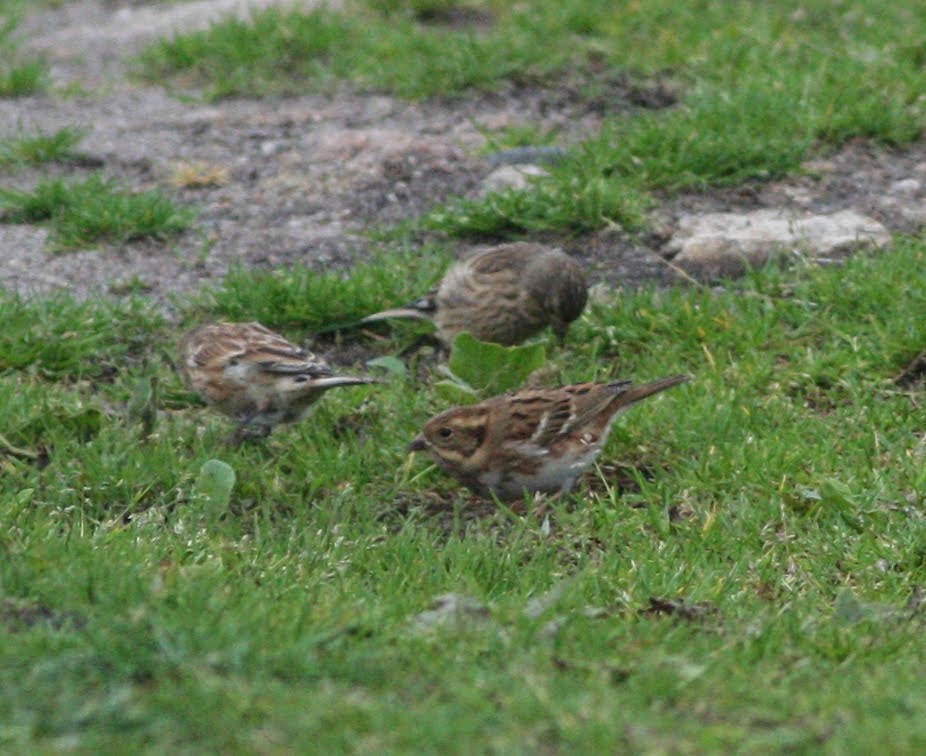
Rustic Bunting

Five minutes later and there it was, feeding happily in full view with a flock of Linnets in thickening drizzle - right place (close by, and with mobile reception), right time, with only fleeting views apparently gained later. Wingletang had been attracting Lapland Buntings in the preceding days, and a very accomodating flock of eleven allowed close approach along the eastern path - a species which became an overall trip highlight, brightening many a quiet walk between Horse Point and Covean.

The 5th produced a little more alongside a dusting of expected common migrants - catching up with Wryneck, two Firecrests and a Marsh Harrier on Gugh was a pleasure, while Agnes held little of note, despite the usual countless rounds from us all. The 6th, meanwhile, was even quieter - single Pied and Spotted Flycatchers, a few Golden Plovers and Wheatears were a stark return, and the flock of Lapland Buntings on Wingletang (thirteen today) were more than welcome respite.


Marsh Harrier

Four days in and with comparatively little to show, it seemed the Anti-American deflector shield over the islands (likely an invent of Shetland or Hebridean origin) was once again at maximum power; word of neartic passerines making landfall on seemingly every other available isle and headland along the east Atlantic seaboard from roughly the 6th to the 9th and beyond at least provided further inspiration - which in truth was far from required.


Lapland Buntings

The popular belief endlessly trotted out in recent years of Scilly being 'dead' and 'over', the rise in popularity of other migratory honeypots and outposts, and the subsequent near-desertion of the islands by the pagered masses went a long way to convincing me that it was just the right time to get acquainted with Agnes; combined with the beauty and serenity of the island, and the opportunity to join a committed team of Agnes faithfuls (all of whom are razor-sharp in the field and fine company out of it), it was an easy and timely decision.

And last year's relative drought only served to strengthen the faith, which would surely be rewarded in the coming days.....