Champions of the Flyway!

Showing posts with label Brambling. Show all posts

Thursday, October 31, 2013

Filey, 6th - 31st October 2013

Mealy Redpoll

So October 2013 finally idles to a halt, after plenty of highly enjoyable, always pleasurable and occasionally exceptional birding here in Filey. Another lengthy period to cover in a single bulletin, but with several of the more special days having already been amply covered of late, not quite the insurmountable task it may first appear to be.....

Knot

The first five days of the month, generally pretty subdued, were previously covered here; the 6th, however, was unexpectedly memorable for the impressive passage of 1,850 southbound Pink-footed Geese, which we enjoyed over a couple of warm and sunny mid-morning hours from the nearby clifftop. The 7th, 8th and 9th were equally mild, with winds remaining stubbornly in the west; hence, two Yellow-brows in Parish Wood and a Curlew Sand at the Dams were appreciated bonuses, and a Balearic Shearwater feeding offshore was as good as it got on the sea.

Brambling

Which all changed dramatically on the 10th, with howling, gale-force northerlies, raging seas and torrential, squally showers all battering the Brigg hide, happily occupied for an extended seawatch through ubiquitous filters of foam and spray. Six entertaining hours - and two Leachs' Storm-petrels, 150 Sooty Shearwaters, five Pomarine Skuas, plenty of Manxies, Bonxies and ducks (including Velvet Scoters and Long-tailed Ducks) - later, and sadly the light began to fade and it was time to bail out.

Bonxie 
One of many flocks of Bonxies during the northerlies....

But tomorrow is a new day, and the 11th was arguably even better; more howling northerlies and raging seas, but better light, and even better seawatching - including three Long-tailed Skuas, another Leach's, over 250 Sootys, two Balearic Shearwaters, over 150 Bonxies, and ten Blue Fulmars (including the darkest I've ever seen), amid plenty of quality back-up. Absolute bliss.

... and one of many hundreds of Sootys

With the winds veering gradually into the east, intermittent mist and drizzle arriving and seawatching quietening down, I turned my attentions to the land on the 12th and 13th. Constant arrivals of passerine migrants and a healthy changeover of birds meant there was plenty to entertain throughout, with highlights including a Woodlark calling and coasting at head-height along Carr Naze, a small arrival of Mealy Redpolls in Top Scrub, single Twite and Short-eared Owl in-off, and good numbers of common migrants including plenty of Bramblings, Redwings, Robins, Fieldfares, Goldcrests, Wrens and finches. All well and good, but surely there had to be something special hidden amongst the more expected fare?

Little Gull at the Dams

Come the 14th, and still the winds kept an easterly component, still the cloud banks came, and still the birds arrived; but still, the pursuit of more glittering prizes remained challenging, and a Red-breasted Flycatcher fresh-in on Long Lane (plus a couple of Ring Ouzels and Mealy Redpolls) was the best I could do. So it goes.

Whooper Swans

It may not have been quite so clear at the time, but something had to give, and on the 15th, it finally did. What looked like being another initially promising but ultimately anticlimactic morning session patrolling the coastal circuit was turned on its head with a single, isolated, indignant tac from the depths of a hawthorn hedge, and after a few silent and anxious minutes wait, I was up close and eye-to-eye with Filey's fifth-ever Dusky Warbler. Bingo.

you little beauty

Promising conditions continued on the 16th, but aside from a Merlin, more Ring Ouzels, Mealy Redpolls and plenty of common migrants, it was hard work; not that it mattered too much, with the previous day's reward still strongly resonating. The sunny and clear 17th, then, was to be a day reluctantly dominated by chores and errands, and I had to wait until mid-afternoon to hit the patch.....

you little beauty #2

.... and what a blinding couple of hours then unfolded. The trail of events is best absorbed here, but in brief, I was presented with an Eastern Lesser Whitethroat, a Siberian Chiffchaff, two Yellow-browed Warblers and (almost unbelievably) another Dusky Warbler, within barely an hour, and all scarcely ten minutes from my front door. Ultimately, it really is worth the effort.

Eastern Lesser Whitethroat

The latter part of the month has been steady without threatening to hit the same kind of higher gears - more new Yellow-brows, Snow Buntings, a couple of Merlins, more Mealy Redpolls, a few more Twite, superb close encounters with Whooper Swans, more Pink-feet on the move, a cracking Pallas's, and various others notwithstanding - and the dreaded south-westerlies continue to maintain a stranglehold for now. Still, if it's all over for autumn 2013, I can hardly complain. It's been a real blast.

Pallas's (ta Nick!)

One of many migrant Wrens during the easterlies - big, dark, leggy and long-billed.....

Thursday, October 18, 2012

Filey, 12th - 18th October 2012


It was one of those weeks that felt like a month (on account of time and effort in the field), that was entertaining in patches (and provided a handful of scarcities along the way), and yet was ultimately frustrating, with near-misses and false starts the dominating themes. 
 

Yellow-browed Warbler, fresh in to the Top Scrub

At this time of year, it's all about expectations, especially here on the coast with a productive patch on the doorstep. Hence, with uninspiring conditions continuing throughout the previous week, expectations were suitably low, and the few highlights were thus small mercies to be grateful for. 


Ring Ouzel pursued by Magpie, Long Hedge 

However, all that was set to change as the 12th dawned, and we were in the field for first light, full of anticipation. The preceding evening produced strong south-easterlies and torrential rain, and while the weather chart wasn't a classic, it promised plenty – despite the fact that the wind had swung around to a tree-bending, flag-cracking westerly. 
 

Brambling on Carr Naze

With not a great deal to show for the first couple of hours efforts, migrants then counter-intuitively began to arrive en masse through the day, battling hard into the head wind; with comrades Paul and Dan, we covered the northern area multiple times, with military precision and hopes constantly high.....

.and for all the unfulfilled hopes of uncovering a gem, it was an entertaining day. Thrushes and finches arrived in squadrons throughout, some making it no further than the cliff sides or long grasses; Blackbirds, Song Thrushes and Redwings were the most numerous, followed by Chaffinches, Goldcrests, Skylarks, Meadow Pipits, Reed Buntings, Siskins and small numbers of Bramblings, Yellowhammers and other passerines. 


Snow Bunting, Carr Naze

But with mouth-watering arrivals further up the coast, there's no denying the sense of what might have been – especially because of a tantalising near-miss that occupied and ultimately beat us for a good couple of hours on the blustery coastal path on the north cliff; sadly best left as a very promising unstreaked acro.

Working the grassland strip in a line, Paul flushed a plain-looking warbler, which flew low in front of us, ditching down a hundred metres or so away; flushed a second time, we pieced together a few more features, and had reason to get a little more excited; a third time, and it looked very, very good. Even allowing a few inconclusive but mouth-watering photos, the bird was in view for a few seconds, before bolting down the cliffside and deserting us for good. The one that got away, and then some.
 

Purple Sandpiper on the Brigg

The 13th, while lacking the promise of the previous day, at least allowed for easier observing conditions, with a much lighter (moderate) westerly blowing under clear skies. New arrivals were limited, until a cluster of migrants appeared out of nowhere in the north-west corner of the Top Scrub at around 1100 – most were Goldcrests, but travelling with them were a Red-breasted Flycatcher and not one but two Yellow-browed Warblers.

An unexpected pulse of action that was over in seconds; otherwise, the morning was mainly as you were, with good numbers of thrushes and finches, always welcome Lap and Snow Buntings, and a smart Great Northern Diver close in and north.


The 14th was mainly bright with a variable strength northerly, and relatively small numbers of new arrivals of species previously mentioned – often promising, especially with birds dropping onto the grassy slopes of Carr Naze regularly – but never quite hitting a higher gear. A similar story for both the 15th and 16th – many hours each day fine-tooth-combing the area, with limited rewards.

Those rewards did include another Yellow-browed Warbler (my sixth of the autumn here) in Long Lane on 15th, and a smart male Ring Ouzel in Long Hedge on 16th; perhaps most interesting was another teaser, towards the south of Long Lane on 15th. A Lesser Whitethroat, with pale lores, a brownish tone overall and extensive white in the outer-tail feathers intermittently appeared close by and looked a good candidate for an eastern race, but didn't fancy posing for photos or prolonged views. 

 
Sparrowhawk, Top Scrub

A similar theme for the 17th and 18th – diminishing returns in less promising conditions, although always with just enough encouragement to justify further multiple rounds of the hedges, copses, fields and clifftops. (And all these Jays straight from the continent are a blast).

So, on paper, far from dreadful – several Yellow-brows and another RB Fly to add to the self finds this autumn, some fine migration spectacles to enjoy, good company and, in patches, very entertaining birding. But, along with somehow conspiring to miss local scarcities including Marsh Tit, Black Guillemot and Little Auk by minutes over the last few days, and as I write (from the Scarborough hospital canteen) a Rosefinch in an area I've flogged endlessly all week (including this morning), it's a file-under-forgettable kind of week.


Next week? No expectations. At all.

Thursday, May 3, 2012

Filey, 27th April - 3rd May 2012


Brambling, Short Hedge, 2nd

So much for the month ending quietly..... as mentioned in last week's summary, April was seemingly on course to sputter out under characteristically dark skies, low pressure, plenty of rain and unhelpful winds. Thus a mainly sunny (albeit blustery) afternoon in the southern area on the 27th was a welcome if pretty quiet break from the storms. Aside from a trickle of northbound Swallows and a Wheatear on the (closed, largely submerged) golf course, the action was limited to the bay, where there were a pair of Shovelers, 15 Common Scoters, two each of Velvet Scoter and Eider, around 15 Sandwich Terns and a couple of distant Common/Arctic Terns.


 Bullfinch, Parish Wood

The 28th saw the wind swing a little more promisingly into the north-east, although the dark skies, blustery conditions and showers made birding difficult. A full circuit of the northern area was notably quiet, until the last few metres of habitat - when a cracking male Ficedula Flycatcher braved the wind and announced its most welcome presence. A Pied would have done just fine, but after further scrutiny and subsequent feedback it seems it was a little more interesting.


Common Redstart, Church Ravine, 30th

Further lousy weather ruled out any activity the following day, but cross-referencing the various forecasts and charts for the 30th quickened the pulse significantly; hence, an early alarm was set despite a pre-booked session (and an obligatory skinful) into the early hours the preceding evening. And mercifully, the forecasts held true - the winds had duly calmed and swung easterly overnight, with torrential rain replaced first by higher cloud and then fog.


Avocets on a temporary flash by the sports fields, 30th

Fog, as in a full-on, dry-ice grey-out. Walking north along the cliff shortly after dawn, the sea was greatly amplified and yet completely obscured, and the two-hour window I had before having to bail out for prior engagements grew increasingly precious. Reaching a Carr Naze (the grassy plateau and its deep gorges that crown the Brigg) undisturbed by dog-walkers was a rare treat in itself, and in the beautifully calm, atmospheric gloom, migrants were suddenly everywhere.

Tame (and evidently knackered) Robins and Wheatears hopped along the path, unphased by my presence; redpolls and then Yellow Wagtails buzzed invisibly in gloom, followed by the first of at least three Tree Pipits. It was more than obvious it was game on, and with not a soul around, savouring the experience was a real pleasure. Next up, a Ring Ouzel - also the first of at least three - flashed across the path and into a gully, and the trickle of Swallows materialising from the fog became a steady, twittering stream.


A few steps further on, and bingo - a Wryneck, up from the path, along the cliff and out of sight just beyond the roman signal station. Further careful stalking (perhaps predictably) made for very limited success, and despite a second view and seeing exactly where it landed, the bird dissolved into the slopes within a second or two. No matter, a great bird at any time, especially in the spring.


More migrants followed (including e.g. Lesser Whitethroat and Sedge Warbler), but my time was up, at least for the rest of the morning. As the day wore on, the fog gradually burned away, leaving a bright and sunny afternoon; perfect. Back out as soon as possible by mid-afternoon, a Common Redstart on the entry path (a few minutes from the front door) was the harbinger of a Church Ravine loaded with fresh arrivals.


A particularly hygienic Wheatear, Carr Naze
 

A conservative count of 28 Willow Warblers here (a personal count of 62 for the day was doubtless a fraction of the overall total), as well as plenty of Robins, Chiffchaffs and Blackcaps, Common Whitethroat, and two Yellow Wagtails on the neighbouring field were great value, and then a brief session at Long Lane and the Top Scrub revealed more of the same; brief on account of the arrival of two Avocets (a real local rarity) at a temporary flash nearby.

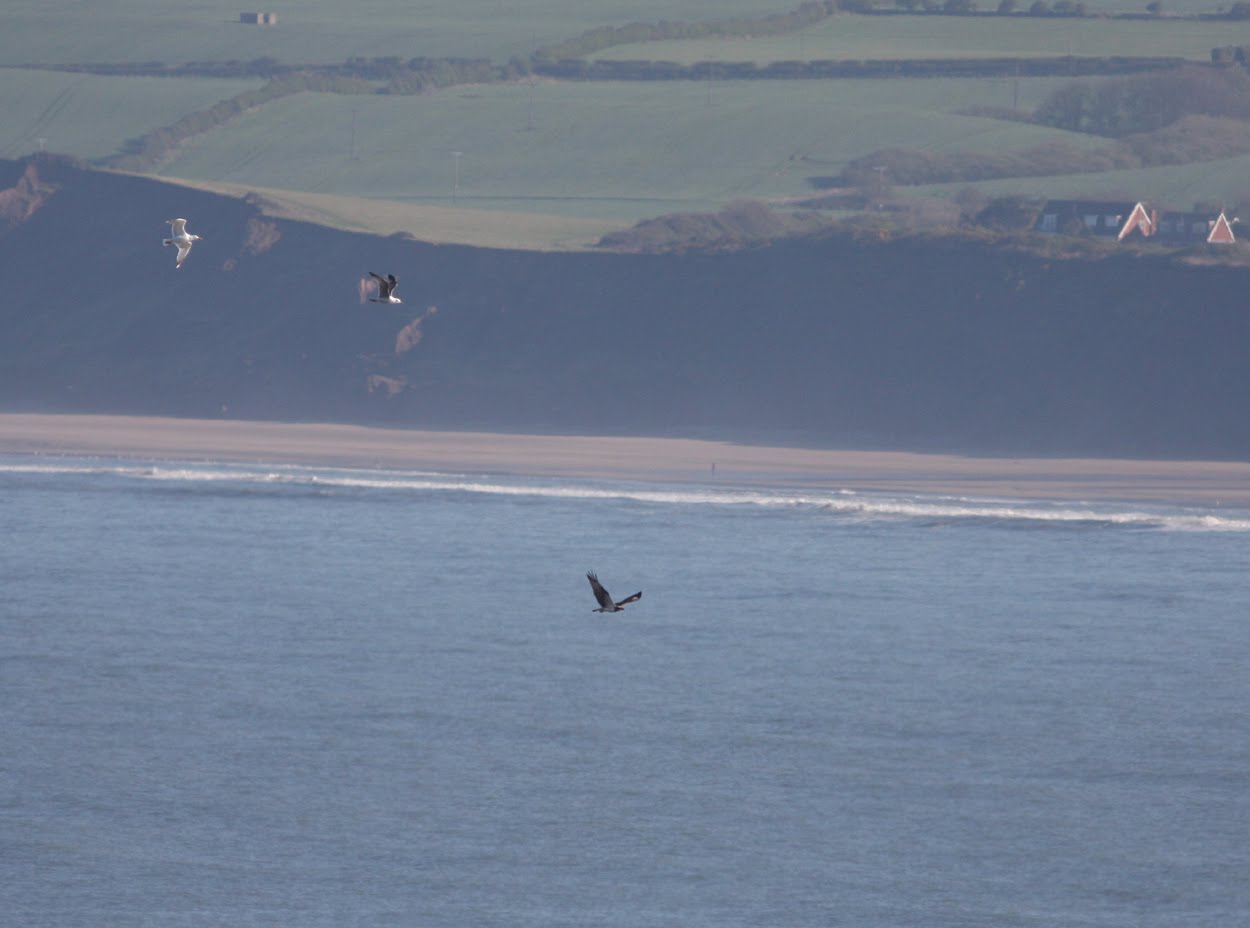
Back to the north-east area for the last couple of hours, and more migrants fresh-in included 12 Whinchats in the Totem Pole Field, another Ring Ouzel, and plenty more Wheatears along the cliff and in the Carr Naze area. Thanks to the frantic yelling of John and Frank (who needs walkie talkies?) I connected with an Osprey, just as it approached us, in off the sea in the evening sunshine. The kind of day that, if ever it were needed, reminds me why moving here was a very smart move. And then of course, to cap it all, there was this... hauling the DSLR around never seemed so righteous.


Osprey in off over the bay, 30th

As for the 1st of the new month, a return to blustery, dull, unhelpful conditions, and with a certain bird in situ at South Landing only about 15 miles away, it would've been rude not to stop by and say hello.


Back on patch first thing on the 2nd, and a full circuit of the northern area in cool, dark conditions with a blustery NNW was relatively quiet; but still, what few birds were around included some quality, not least in the shape of a tame, vocal and frankly beautiful Brambling, and an altogether more brutish Hooded Crow kicking around with the local marauding corvids around the old tip.


As honeymoon periods go, this is about as good as it gets. Bring on May.


Hooded Crow, 2nd