Champions of the Flyway!

Monday, February 6, 2012

Butterflies of Periyar


The jungle's variety and abundance of butterflies was remarkable, and often breath-taking (rivalled on the trip perhaps only by the equivalent sub-tropical montane forests in Taiwan). One particular forest opening - black volcanic rock overlaid with low scrub and a variety of flowers - was particularly Disney-esque, with many butterflies clouding around and landing on us, especially when the sun broke through mid-morning on the first day. The birds were excellent here to, and then there were the Giant Squirrels and Nilgiri Langurs; a riot of wildlife in one secluded clearing.


This one's for my old man - with us in spirit throughout the trip, and no more so than here......


Sunday, February 5, 2012

Periyar - more avian highlights

  
Darter


Malabar Whistling Thrush - a stunning inhabitant of wooded streams in the jungle


Rusty-tailed Flycatcher


Nilgiri Flowerpecker


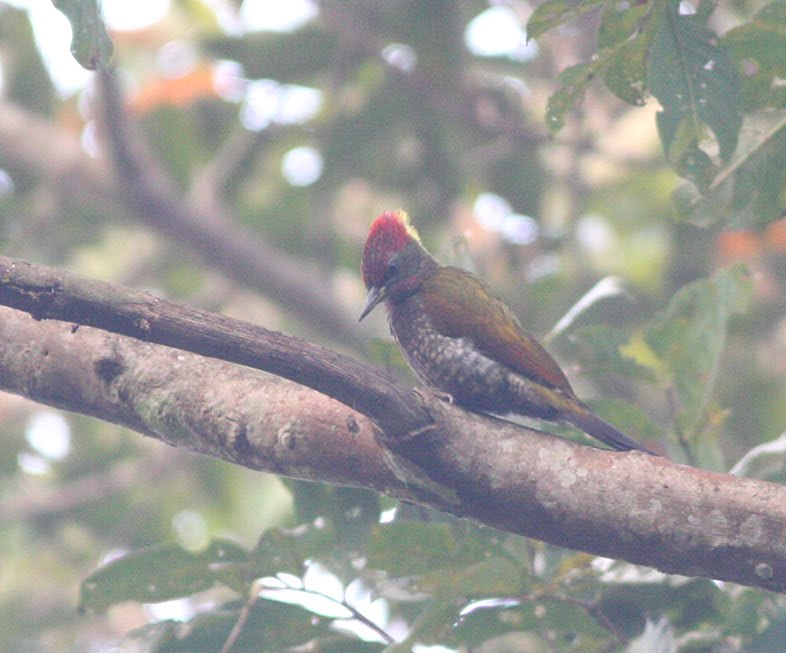
male Yesser Yellownape - a smooth operator


making a move

 
caught in the act


Brown-breasted Flycatcher


White-browed Wagtail

Saturday, February 4, 2012

Periyar, Kerala - endemics and more


male Crimson-backed Sunbird - a tiny, beautiful endemic of the Western Ghats


Once across the lake, into the jungle and away from the honeypot and its visitors, the nature of the forest soon came into sharp focus. Knowing where to look was the main problem, with sensory assaults courtesy of mammals, butterflies, insects, plants, fungi, reptiles, amphibians, flowers, and plenty more challenging the array of birdlife for our attentions. While the latter often won out, it was a much closer call than usual.


Blyth's Reed Warbler

But the birding was indeed exceptional. With Raj fully primed and in fine form, possibilities became probabilities and then often became surefire over the course of our two lengthy sessions, and included a glittering roll-call of regional endemics, local specialities and rare migrants.


Greenish Warbler


Sri Lankan (Ceylon) Frogmouth 

The highlights? A long list. Strictly local specialities included Malabar Parakeets, Malabar Trogons, Malabar Woodshrikes, Malabar Starlings, Malabar Barbets, Malabar Grey Hornbills, Malabar Whistling Thrushes, Nilgiri Flowerpeckers, Crimson-backed Sunbirds, Yellow-browed Bulbuls, White-bellied Treepies and Indian Rufous Babblers.


Malabar Barbet

Flycatchers seen were top quality, with a first Brown-breasted (a scarce species with a very limited winter range), a good scattering and great views of stunning White-bellied Blues (a scarce endemic of the Western Ghats),  a couple of Rusty-tailed (with a winter range almost confined to the Keralan forests), and a reliably gorgeous Asian Paradise.


Jungle Babbler - common in marauding, noisy and unavoidable gangs

Warblers were hard work but ultimately very rewarding, with single Western Crowned and Large-billed Leaf Warblers both personal firsts, backed up by a good showing of Greenish and Blyth's Reeds (not to mention those that got away, naturally). 


 Chestnut-tailed Starling (migrant ssp. malabarica)

Endlessly excellent back-up was provided by a Rufous Woodpecker, Puff-throated Babblers, Greater & Black-rumped Flamebacks, Red Spurfowls and Grey Junglefowls, Indian Swiftlets, Indian Golden Orioles, Southern Hill and Jungle Mynas, Forest Wagtails, Orange-headed Thrushes, Asian Fairy Bluebirds, mating Lesser Yellownapes and much more.


Common Kingfisher on our bamboo raft - with a fish pretty much as long as the bird itself


A Sri Lankan Frogmouth at point-blank range (Amity only just about resisting the overwhelming urge to tickle its chin) was predictably wonderful, and a call-and-response session with a very confident Jungle Owlet (of the endemic subspecies) were two more highlights of a wonderful place, highly recommended and often overlooked by visiting birders.


(More to follow)

Friday, February 3, 2012

meanwhile, back in east London.....


 a different kind of jungle entirely

..... and with apologies for briefly breaking the flow of posts from our travels. As many have probably gathered (from, for example, the Desert Wheatear post a few weeks ago), we are indeed back in Europe - although still free-range for the time being - and with the present cold snap kicking in, a brisk walk around a familiar local patch seemed like a good way to kill a sunny day in the city.


This is (apparently) the first seriously cold weather system of the winter so far, and while local birding options are somewhat limited (especially in the dead of winter), Walthamstow at least provides an opportunity to check for an interesting duck or two in such circumstances. And so, a brisk walk around the northern complex - exposed, bleak, and numbingly cold, but also crystal clear, blue-skied and beautiful - was a solitary pleasure, and produced the goods.

Plenty of the commoner wildfowl species scattered across the reservoirs, but the Lockwood always seems to hold the most promise, and it didn't disappoint today - six Goldeneye, six Goosander, and with the latter the star of the show, a female Red-breasted Merganser.


Using a 'scope for the first time in about nine months was a cumbersome necessity, hence no DSLR shots today - but instead, short n' crappy digiscoped films (seemingly soundtracked by either incoming messages from Ganymede or a lo-fi bootleg of Lou Reed's Metal Machine Music, you decide).

Thursday, February 2, 2012

Periyar, Kerala - into the jungle


 (to get to the other side, obviously)

After picking up Raj in the village and hailing a tuk tuk just as dawn began to break, we reached the small car park a couple of km within the reserve shortly afterwards, and were immediately into quality birds - before the first coach trip of the day rolled in, we enjoyed brief trackside views of both Grey Junglefowls (male, above) and Red Spurfowls (below); the following morning, we tried again a little earlier, and scored prolonged and closer views of both species.


From there, we made our way to the guide's cabin on the lake shore, where we decked ourselves out in leech-resistant stockings; an essential part of the kit, as we were soon to find out. Although by no means leech-proof, the material at least served as a barrier to the countless thousands of blood-suckers we were soon to be sharing trails and clearings with.


The guide's cabin (left), and the path to the bank (centre)....


.... and the transport across the lake and into the reserve proper


Raj - note colour-coordinated pen and visiting bug 

 
From there, a bamboo raft across the lake and onto the opposite bank, where Raj produced his secret weapon - tobacco powder, sprinkled over and inside shoes, giving us total protection against the leeches; and then, into the jungle, and two consecutive mornings brimming with natural wonders and bouts of sensory overload.

(bird and wildlife photos to follow)


Periyar wildlife sanctuary, Kerala - Dec 2011 (pt.1)


Malabar Woodshrike - a smart Western Ghats endemic

We spent two memorable days in the reserve, deep in the unique subtropical biotope of the Keralan Western Ghats, and a short tuk-tuk ride from our accommodation in the neighbouring border town of Kumily. Thanks once again to the glories of the internet, we struck lucky, this time with a local guide par excellence who made a potentially good couple of sessions truly blinding.


Reading through a birder's trip report online, we followed up on a recommendation to seek out Raj, one of the many wildlife guides who are employed by the reserve to lead small groups of visitors around accessible areas. Of the large numbers of visitors (almost all Indian), the majority take the boats out across the lake - stunning views, but minimal wildlife, and no peace. So, the jungle for us.


Greater Flameback


Oriental Honey-buzzard

But first a little manoeuvring, which involved hooking up with Raj the previous evening in town (critically the trip report included a mobile number for him), buying our reserve passes at an office in Kumily (this being India - it would be far too straightforward to get them at, say, the reserve entrance), and arranging to pick him up via tuk tuk before dawn the following morning. This way, we'd enter the reserve together, and we'd avoid the standard practice of being allotted a random guide.


A good practice it is too - small groups are accompanied by a guide, all of whom are from the local indigenous tribe and very knowledgable about the park's flora, fauna and history. But ideally, we needed someone who was on the money with the reserve's avian delights, especially those less common and harder to find; enter Raj - highly skilled, committed to seeking out the most esoteric of targets, and a pleasure to spend time with. Part two to follow.


Jungle Owlet - we played call and response, complete with unnerring eye-contact, for a long time with this little chap (n.b. the old school way, not with playback)