Champions of the Flyway!

Friday, May 11, 2012

Filey, 8th - 11th May 2012


Short-eared Owl, 10th

Showers overnight and a southerly airflow for the 8th - a second consecutive day of southerly winds being a rare occurrence so far this spring - brought modest returns, with visible migration evident but few grounded migrants; the highlight was a cream-crown Marsh Harrier high and in off the sea, while other notables included high flying flocks of corvids (mainly Carrion Crows), Yellow Wags, a Whimbrel and Hirundine migration that very much stole the show.


Another photo of another Wheatear - not why, but why not

Personal counts of 650 Swallows, 290 House Martins and 200 Sand Martins were doubtless a fraction of the true figures moving through in an impressive, constant flow, and the wire fence along the north cliff was often weighed down with dozens of birds taking brief rests; and as could be seen when scanning from higher ground, birds were moving along at least several different main flightlines. Hence, 'thousands' is probably the best (if somewhat downplaying) description of numbers.


A Cuckoo circumnavigating blissfully unaware tourists

The morning of the 9th was pleasantly mild and sunny with a light easterly, and a wander around the south side produced limited results, although a Cuckoo along the cliff path and a Garden Warbler singing at the bridge were both firsts for the year. Plenty of other common migrants were evident, with up to 50 Swifts and a good scattering of warblers - most notably Common Whitethroats, seemingly occupying all available habitat. The afternoon became gradually cooler, cloudier and breezier (from the east), but the best of several hours on the northern circuit were three Common Sandpipers together on the rocks below Carr Naze.


Common Swift - uncommonly magical

And so to the 10th, a day of clashing weather systems and changing conditions; once again, the entertainment was incoming and overhead (as opposed to in situ), and the sight of two fresh-in Short-eared Owls instantly patrolling the cliff edge was a pleasure, especially when one promptly caught breakfast and then staged a close-up fly by for good measure.


Wren

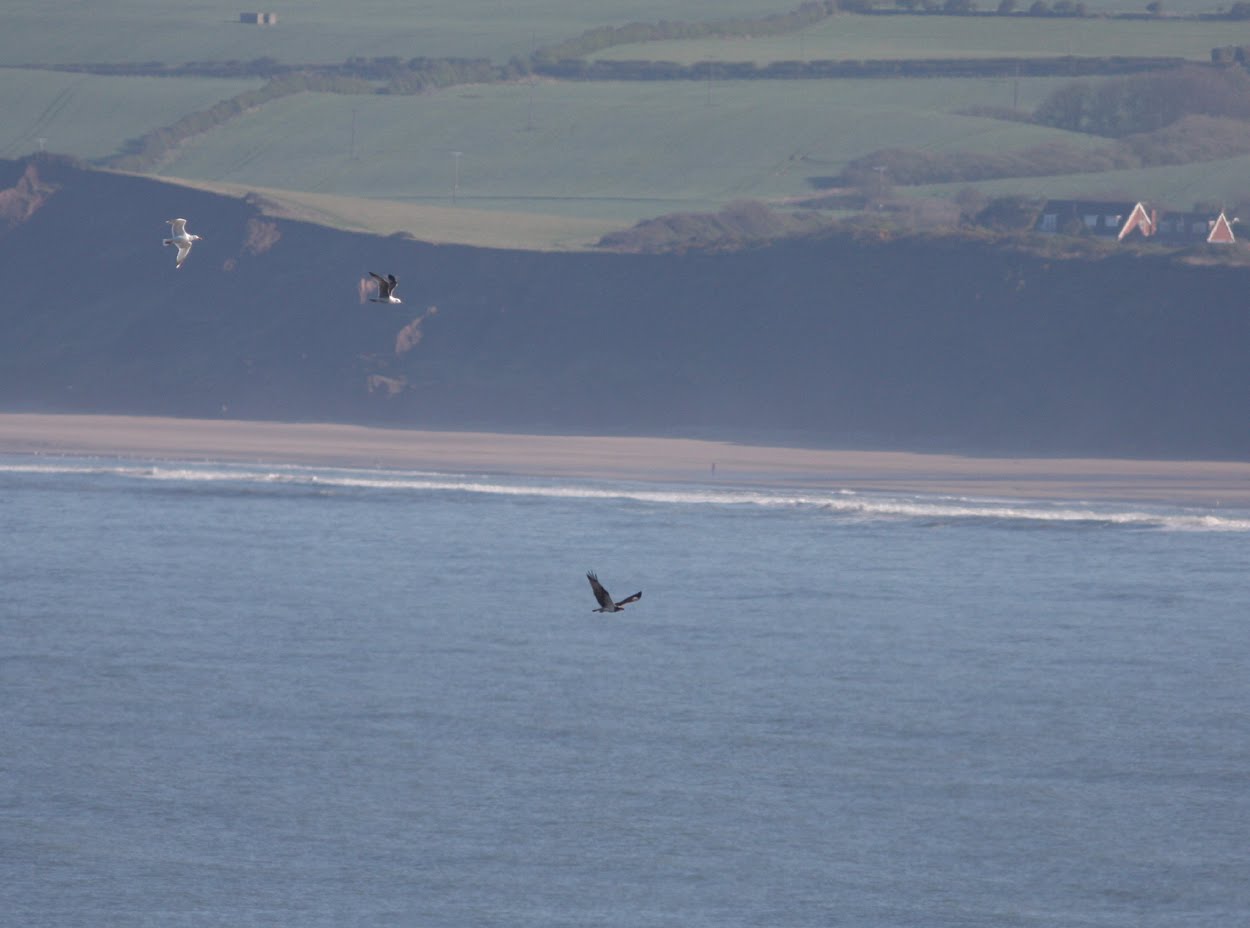
Hirundines continued to plough through, with all three species reaching double figures again as well as other common migrants in small numbers (including six Wheatears on the Naze - the majority at least being new birds based on plumage and sex). However, it took til early afternoon for the highlight of the day, which appeared low over the top scrub before disappearing over the cliff-edge - an Osprey, the second of the spring, and always a thrill.


Osprey, 10th

So May thus far has been pretty hard work, with circumstances, in common with April, being far from advantageous; generally messy conditions, ascendant low pressure systems and a lack of any sustained southerly airflows has somewhat curtailed possibilities so far. Although, it being spring, there have been highlights on most days, and all it takes is a change in the weather for something special to happen.....


Barnacle Goose (belatedly), Filey Dams, 4th

Thursday, May 10, 2012

Filey, 4th - 7th May 2012

 
The week began with blustery northerlies, low temperatures and squally showers on the both the 4th and 5th. Plenty of hours throughout the area for pretty scant returns, and a Barnacle Goose of unknown origin (of unknown origin - what a strange, almost esoteric term that is), a drake Wigeon and a Yellow Wagtail were the best of the disappointing Dams still hamstrung by very high water levels. 


Tawny Owl, Church Ravine

Much of the entertainment came from the bay on the latter date - with 33 Purple Sandpipers and 29 Oystercatchers in the high tide roost, and 25+ Sandwich Terns, 100+ Common Gulls north, 11 Eider, 14 Common Scoters, two Velvet Scoters and three Great Crested Grebes out on the water.


Plenty more effort on the 6th, with the wind in the north-west and a little more sunshine, and more pretty limited returns; a White Wagtail and five Wheatears on Carr Naze were the pick (as well as a Tawny Owl out in the open in Church Ravine, always a pleasure).


Hopes were higher for the cool and mainly sunny 7th, with overnight south-easterlies holding through the day (and becoming stronger throughout). Brief views of a distant ring-tail Harrier went frustratingly unrequited early on, but visible migration continued; five Yellow Wagtails, a Tree Pipit, a Whimbrel, a Siskin and three Shelducks in off, and hundreds of hirundines (many into the wind and along the Brigg) were overhead inspiration while covering the northern area throughout the morning and into the afternoon.


Summer plumage Dunlin, Carr Naze pond 


Shelduck in off the sea

All good, but with such a wind at such a time of year, surely more to follow; so when news came through of a Stone Curlew freshly discovered by Frank at the southern edge of the area (a new bird for Filey, which can't happen too often these days), a polite scramble ensued. A great bird, keeping the spring flag flying high with several weeks of potential quality still to come....


Stone Curlew

Wednesday, May 9, 2012

Home improvements, Filey style


The local Kittiwakes decided to start building their nests today en masse, prompting a procession between the beach (for materials) and the cliffs, with occasional pit stops to bathe in Carr Naze pond. Amongst other surveying projects upcoming, I'll be monitoring a section of the colony here over the coming months for the RSPB, so more on these most beautiful and charismatic of gulls to come.


Monday, May 7, 2012

Stone Curlew - Filey, 7th May 2012


What a spring - so far.....  more to follow anon.


Sunday, May 6, 2012

Some Velvet Morning


A quiet day on the patch, with icy northerlies and that rare local commodity once known as sunshine conspiring to produce few new arrivals but a weak surge of very welcome vitamin D. Nonetheless, in the spirit of there always being something to get a kick out of, a couple of hour's baywatch produced, amongst other things (including 33 Purple Sandpipers in the high tide roost) entertaining seafowl out on the surfable tide:


In perhaps the least productive of period of the year for seaducks, a total of 14 Common Scoters, two Velvet Scoters and ten Eiders, from a bench conveniently located on the clifftop about twenty seconds from my front door, is frankly a joy.

Saturday, May 5, 2012

The Olive-backed Pipit - Filey, 30th April 2012


More time, and so a little more to add. After an already killer day in the field (see here for full details), this eastern jewel appeared out of nowhere, on the very edge of the cliff on Carr Naze, directly between the waning evening sun and the camera lens (which was pleasantly preoccupied with close-up Wheatears at the time). Instinctively sticking with the DSLR as opposed to changing over to optics, it turned out to be all or nothing for a few precious seconds.


Calling twice, hop-scotching a couple of metres and staying in view just long enough to give me a clear shot, its presence was (almost) painfully brief, and that it was registered at all was down to pure luck. Or more accurately, luck and technology. A combination of factors, however, conspired to write a happy ending, including the bird landing exactly where it did and for just enough time, the camera locking onto it mercifully quickly, and (critically) the relative angle(s) of the bird, which provided an ultimately defining suite of i.d. features.


A happy ending indeed, which I'm tempted to take as a slightly delayed 40th birthday present, celebrated into the early hours the previous evening, and intermittently again ever since thanks to this bird.

Thursday, May 3, 2012

Filey, 27th April - 3rd May 2012


Brambling, Short Hedge, 2nd

So much for the month ending quietly..... as mentioned in last week's summary, April was seemingly on course to sputter out under characteristically dark skies, low pressure, plenty of rain and unhelpful winds. Thus a mainly sunny (albeit blustery) afternoon in the southern area on the 27th was a welcome if pretty quiet break from the storms. Aside from a trickle of northbound Swallows and a Wheatear on the (closed, largely submerged) golf course, the action was limited to the bay, where there were a pair of Shovelers, 15 Common Scoters, two each of Velvet Scoter and Eider, around 15 Sandwich Terns and a couple of distant Common/Arctic Terns.


 Bullfinch, Parish Wood

The 28th saw the wind swing a little more promisingly into the north-east, although the dark skies, blustery conditions and showers made birding difficult. A full circuit of the northern area was notably quiet, until the last few metres of habitat - when a cracking male Ficedula Flycatcher braved the wind and announced its most welcome presence. A Pied would have done just fine, but after further scrutiny and subsequent feedback it seems it was a little more interesting.


Common Redstart, Church Ravine, 30th

Further lousy weather ruled out any activity the following day, but cross-referencing the various forecasts and charts for the 30th quickened the pulse significantly; hence, an early alarm was set despite a pre-booked session (and an obligatory skinful) into the early hours the preceding evening. And mercifully, the forecasts held true - the winds had duly calmed and swung easterly overnight, with torrential rain replaced first by higher cloud and then fog.


Avocets on a temporary flash by the sports fields, 30th

Fog, as in a full-on, dry-ice grey-out. Walking north along the cliff shortly after dawn, the sea was greatly amplified and yet completely obscured, and the two-hour window I had before having to bail out for prior engagements grew increasingly precious. Reaching a Carr Naze (the grassy plateau and its deep gorges that crown the Brigg) undisturbed by dog-walkers was a rare treat in itself, and in the beautifully calm, atmospheric gloom, migrants were suddenly everywhere.

Tame (and evidently knackered) Robins and Wheatears hopped along the path, unphased by my presence; redpolls and then Yellow Wagtails buzzed invisibly in gloom, followed by the first of at least three Tree Pipits. It was more than obvious it was game on, and with not a soul around, savouring the experience was a real pleasure. Next up, a Ring Ouzel - also the first of at least three - flashed across the path and into a gully, and the trickle of Swallows materialising from the fog became a steady, twittering stream.


A few steps further on, and bingo - a Wryneck, up from the path, along the cliff and out of sight just beyond the roman signal station. Further careful stalking (perhaps predictably) made for very limited success, and despite a second view and seeing exactly where it landed, the bird dissolved into the slopes within a second or two. No matter, a great bird at any time, especially in the spring.


More migrants followed (including e.g. Lesser Whitethroat and Sedge Warbler), but my time was up, at least for the rest of the morning. As the day wore on, the fog gradually burned away, leaving a bright and sunny afternoon; perfect. Back out as soon as possible by mid-afternoon, a Common Redstart on the entry path (a few minutes from the front door) was the harbinger of a Church Ravine loaded with fresh arrivals.


A particularly hygienic Wheatear, Carr Naze
 

A conservative count of 28 Willow Warblers here (a personal count of 62 for the day was doubtless a fraction of the overall total), as well as plenty of Robins, Chiffchaffs and Blackcaps, Common Whitethroat, and two Yellow Wagtails on the neighbouring field were great value, and then a brief session at Long Lane and the Top Scrub revealed more of the same; brief on account of the arrival of two Avocets (a real local rarity) at a temporary flash nearby.

Back to the north-east area for the last couple of hours, and more migrants fresh-in included 12 Whinchats in the Totem Pole Field, another Ring Ouzel, and plenty more Wheatears along the cliff and in the Carr Naze area. Thanks to the frantic yelling of John and Frank (who needs walkie talkies?) I connected with an Osprey, just as it approached us, in off the sea in the evening sunshine. The kind of day that, if ever it were needed, reminds me why moving here was a very smart move. And then of course, to cap it all, there was this... hauling the DSLR around never seemed so righteous.


Osprey in off over the bay, 30th

As for the 1st of the new month, a return to blustery, dull, unhelpful conditions, and with a certain bird in situ at South Landing only about 15 miles away, it would've been rude not to stop by and say hello.


Back on patch first thing on the 2nd, and a full circuit of the northern area in cool, dark conditions with a blustery NNW was relatively quiet; but still, what few birds were around included some quality, not least in the shape of a tame, vocal and frankly beautiful Brambling, and an altogether more brutish Hooded Crow kicking around with the local marauding corvids around the old tip.


As honeymoon periods go, this is about as good as it gets. Bring on May.


Hooded Crow, 2nd

Wednesday, May 2, 2012

Olive-backed Pipit, Filey - 30th April


After an already killer day in the field (see here for full details), this eastern jewel appeared out of nowhere, on the very edge of the cliff on Carr Naze, directly between the waning evening sun and the camera lens (which was pleasantly preoccupied with close-up Wheatears at the time). Instinctively sticking with the DSLR as opposed to changing over to optics, it turned out to be all or nothing for a few precious seconds.


Calling twice, hop-scotching a couple of metres and staying in view just long enough to give me a clear shot, its presence was (almost) painfully brief, and that it was registered at all was down to pure luck. Or more accurately, luck and technology. A combination of factors, however, conspired to write a happy ending, including the bird landing exactly where it did and for just enough time, the camera locking onto it mercifully quickly, and (critically) the relative angle(s) of the bird, which provided an ultimately defining suite of i.d. features.


Reviewing the photos brought on that heady mix of restrained elation and mild panic, and despite the apparently conclusive evidence, opinions from various trusted observers were sought; plenty of helpful input came in over the next day or so, with the i.d (and sanity) gratefully upheld.

A happy ending indeed, which I'm tempted to take as a slightly delayed 40th birthday present, celebrated into the early hours the previous evening, and intermittently again ever since thanks to this bird.

Tuesday, May 1, 2012

The Flamborough Flycatcher, 1st May 2012


After a wonderful day's birding here at Filey yesterday (see here), today reverted to recent type, with dark skies, moderate north-easterlies and showers. With the opportunity to nip through to Flamborough and a certain black and white Ficedula having hung around, we arrived at South Landing around midday and found the bird performing admirably along the eastern side of the gulley (in exactly the same area favoured by the Taiga Flycatcher a few years back).


A blaze of gleaming white and deep, velvet black, it proved to be one of those birds which is so good to watch it almost didn't matter what it is or isn't as it hawked insects from hawthorns and low sycamores. With DNA results awaited within the week and speculation rife, it seemed surprising to find only a couple of dozen admirers at any given time lining the track. Still, it made for a more pleasant and relaxed experience all round, especially on the top path, where just a few of us enjoyed a stake out with excellent close-up results.


A quality bird, and big thanks (yet again) to Rich - Flamborough really is such a better place for birds and birders these days.

Saturday, April 28, 2012

Semiconverse Flycatcher - Filey, 28th April


Out since first thing under leaden skies and with a blustery north-easterly blowing, it looked like today's notebook entry for the morning circuit around the northern area would make for, well, very light reading; until this interesting little gem appeared that is, in the last few metres of habitat before the walk back through town.


A highlight in any circumstances (let alone with barely any other sign of migration evident), this stunning male 'Pied' Flycatcher was another timely reminder to keep the faith. Understandably elusive given the crappy conditions and often going awol for long periods, most locals nonetheless caught up with it subsequently as it kept its distance at the southern end of Parish Wood.


With just a couple of us left, it wasn't until the bird finally came low enough to briefly show its upperparts that alarm bells rang, however mutedly. While tracking the bird through the camera's viewfinder failed in getting a clear shot, it succeeded in revealing a surprisingly large, distinctly pale rump patch; in addition, from some angles a diffuse, encouragingly-shaped suggestion of a paler collar could be seen.


We continued to stay with the bird (at least, when it occasionally decided to show) in order to nail further plumage characteristics; possibilities were shuffled around and subdued hopes of something a little more special kept us on our toes (which were unseasonably cold by then).


Alas, most features fit with the initial ID, and the rump and collar problem, though intruiging, may remain just that; although if anyone who knows more wants to try and convince otherwise, I'd be more than happy to hear from them. It seems possible to us that the bird may harbour more than just hypoleuca genes, and thoughts are welcome.


Postscript - a few days on, the majority of opinions expressed from people better qualified than I go for hybrid Collared x Pied.