Back surveying on the south bank of the Humber on (another) very windy day, and the numbers of several species sheltering in a favoured area were exceptional - in a small area of saltmarsh, mud and (construction-protected) open water, dense, swirling flocks of birds included over 3,000 Lapwings and over 2,300 Teal, as well as hundreds of Curlews, Black-tailed Godwits and other wintering regulars.
Just back from a very pleasant Christmas Day and Boxing Day at Flamborough, within which we (the Mrs and I) enjoyed two local gluttony-bustin' walks - South Landing yesterday (25th) and Bempton Cliffs today.
Yesterday was mild, gloomy, breezy and wonderfully quiet at South Landing, with 89 Turnstones on the beach, a few divers and ducks on the sea, 22 Curlews in the fields and a timely and welcome Arctic surprise in the shape of a first year Iceland Gull sneaking north-east (below).
Today was much brighter, cooler and calmer, and Bempton was not only beautiful but also rewardingly birdy; three entertaining Short-eared Owls, 33 Snow Buntings, 560 Pink-footed Geese, three Stonechats, 15 Rock Pipits and more were all gloriously illuminated in the winter sunshine.
30 seconds of the #Flamborough longsword - a folk dance and boxing day tradition in my village, played out by the adult's team (half-cut) and the kid's team (absolutely hammered). pic.twitter.com/u67rK70Kdu
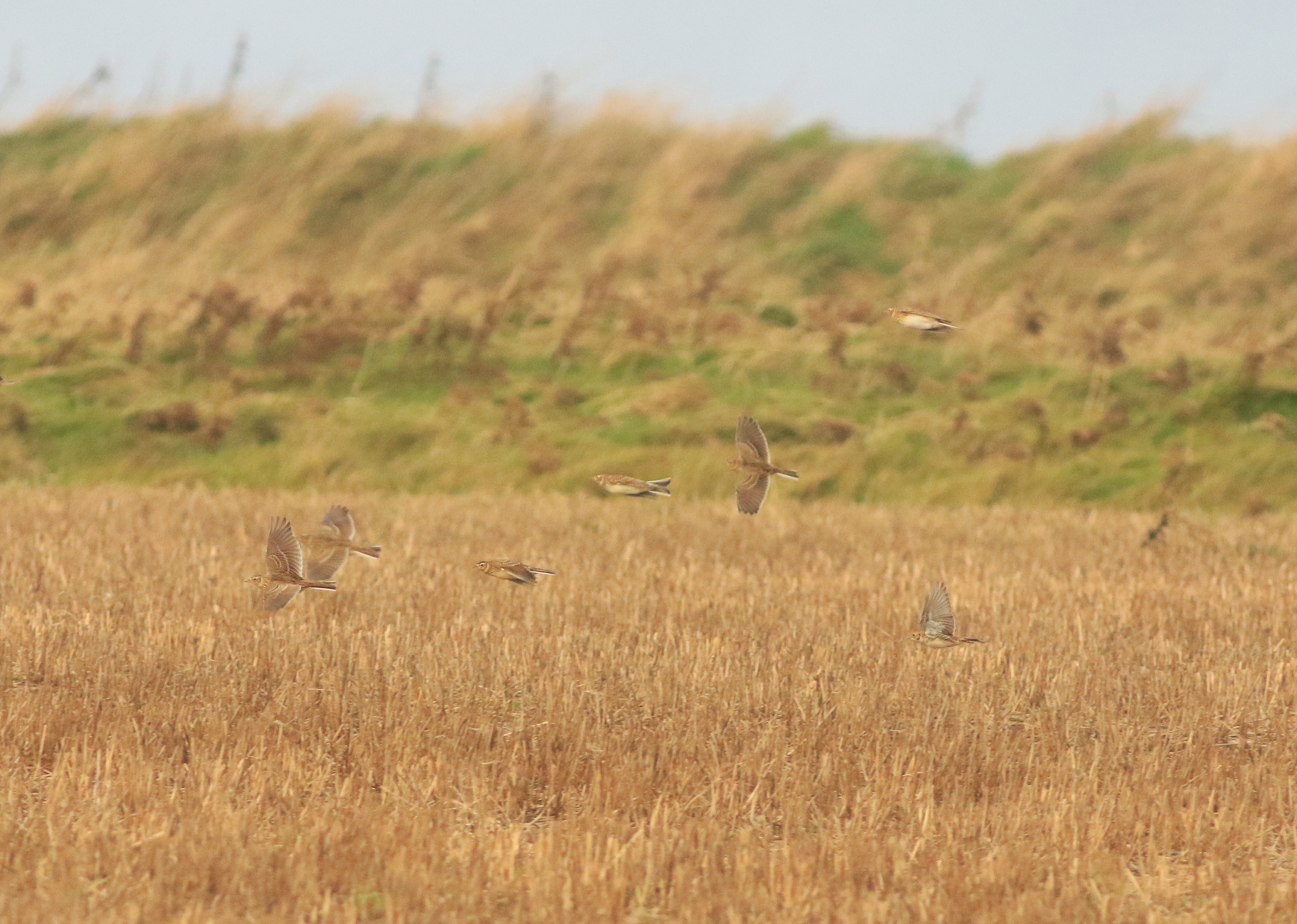
Windy and gloomy but plenty to enjoy up in the North Cliff / Top Fields area here at Filey early this afternoon - the stubbles are presently full of birds (that's what you get for, well, leaving the stubble), with the highlights being 36 Snow Buntings, 22 Lapland Buntings, 110 Skylarks and five Corn Buntings. Quality winter birding!
It's taken a while to get there, but I've finally had the time and opportunity to fully analyse the recordings from the night of 7th-8th October - an incredible night for nocturnal thrush migration here on the Yorkshire coast, and nowhere more so than here at Filey.
I had three recorders running through the night - one at Flamborough, one at Filey North Cliff, and one here in Filey town, in (out of) the study; all three scored highly, but it was the house recorder - trapped in the crack of the window and pointing out into the back alley in the middle of town - that really blew the doors off, smashing records in the process and providing one of most exciting nights of nocmig I've ever had.
In the midst of an exhilarating 48 hours of birding here (see here for the joy of the 7th/8th in the field) - I knew it was going to be a big night; a mass arrival was already underway, the winds were due to swing favourably onshore, the cloud was low, the showers were due to roll in and all the indications were good. It wasn't until I started to go through the spectrogram the following evening, however, that I started to realise just how good....
Much of the night was steady as she goes, with respectable numbers of thrushes, a few waders, and one or two other regular late-ish autumn nocmig migrants; until about 0245hrs, that is, when all hell broke loose. The density and frequency of thrush calls - the vast majority Redwings, but many Song Thrushes and Blackbirds, too (with lesser numbers of Fieldfares and a couple of Ring Ouzels), was like nothing I've ever seen.
A quick scroll onwards showed that, far from a few intense fits and starts, it appeared to be never-ending, and I quickly realised it deserved more scrutiny and accuracy than the usual methods allowed; also, such was the relentlessness and density of the calls on the screen, there was no way of estimating the number of calls via the usual, visual counting method anyway. What to do? There was only one thing for it - I decided to bite the bullet, and listen through the key period manually, via headphones.
Long story short, I spent a lot of time analysing the critical last four hours of the night - 0240-0640hrs - in real time (with various breaks and section re-runs for different species), and analysed the preceding eight hours or so in the usual way, i.e. visually. It was a pretty challenging task, but the results were, well, very rewarding, as can be seen by the final totals:
NB - Many calls were inevitably missed due to interference, particularly during the periods when the rain was heavier and when the wind distorted the recording; this applies especially to Song Thrushes, whose narrow, horizontal call signatures are easily lost in such a scenerio. Additionally, as can be seen by the sheer density of calls, many (especially Redwings) were obscured on the spectrogram as calls overlapped with each other.
Eurovision top 20 - Highest ever Redwing nocturnal migration counts on Trektellen. Three of the top six record counts are from my recorders on the night in question.
Also NB - the figures represent the total number of call registrations, not the total number of birds. Nocmig is an inherently inexact science, and we don't know how many birds actually migrated overhead on that night (or on any others). It's worth bearing in mind, however, that when I've compared nocmig recordings with simultaneous thermal-imaging, the audio has picked up a mere fraction of what's visible in the thermal on each occasion.
A five-minute screengrab of the spectrogram, illustrating the density of thrush calls.....
So why was it such a special night? Well, the conditions were indeed basically perfect for a mass arrival, and the weather systems aligned in such a way as to channel a majority of the birds directly towards our section of the coast. But as to why my house recorder, here in the middle of town, outperformed both my Filey North Cliff recorder (just 1km north of here, and right on the coast) and my Flamborough recorder (which is in prime position on the Great White Cape) - we can only speculate, but we think a major factor is the location in relation to the coast and artificial light.
... and a thirty second screenshot of the same
My house is just a few hundred metres back from the seafront, and while Filey is hardly a sprawling metropolis, it has a density and intensity of electric light sources that theoretically create a far more attractive 'target' for nocturnal migrants to aim for than either the small, scattered sources of a village, or none at all. It may also be that artifical light stimulates the birds to call far more, and this may increase further when the density of individuals intensifies (although see above re: the thermal to audio ratio).
Whatever the causes (and it's fun to speculate, especially with so much more to learn), it stands as the biggest single night of Redwing migration anywhere in Europe (as recorded on Trektellen), more than doubling the previous UK record; it's also the highest ever UK nocmig count for Song Thrushes, with all three of my recorders that night making the top 5 highest UK counts ever. Insane!
Such was the amazing intensity of calls when the floodgates opened before 0300hrs, my notes record that it took until 0558hrs - a full three hours later! - for there to be a ten second gap where no calls were recorded. Crazy scenes....
Thanks to Trektellen, the fantastic migration recording website - see more here: https://www.trektellen.org/
I know, it's been a long time... my excuses are the usuals (busy, away a lot) but are more legitimate than ever - it's been a manic few months even by recent standards, and I'm not long back from an extended, fruitful trip to the Highlands (more on that later). This morning was the first time I've been out on the doorstep in several weeks, and it was a perfect morning for it: -3°c at first light, and everything coated in a thick, sparkling frost.
Snow Buntings - lil' angels every one
I didn't expect too much - a few Snow Buntings, maybe? - but as it turned out, a stomp around the Top Fields / North Cliff was fantastic; birds everywhere, scattered throughout the winter stubbles (a rarity in itself these days).
One of at least four mobile Lapland Buntings
I didn't have as long as I'd have liked, but in the window I had, highlights included at least two (very mobile) Shore Larks, at least four Lapland Buntings (ditto), a minimum of 48 Snow Buntings (including three in off the sea), 18 Snipe and 75 Golden Plovers in off, a Woodcock and 185+ Skylarks. The most productive terrestrial winter session here in a long time....
Part of large flock of low-flying Golden Plovers in off the sea


 Lapwings (above), Roe Deer (below)