FLAMBOROUGH
While it's often a quiet month with low species diversity and abundance, July wasn't without its highlights; all three of the more regular tern species registered, with a flocks of Sandwich Terns on 11th, Common Terns on 29th, and Arctic Terns on 31st, the latter night also featuring a flock of Turnstones. Other waders recorded (in small numbers) included Redshank, Whimbrel and Oystercatcher, while the highlight of the month was a screaming flock of Swifts over the village at 2235hrs on 13th - a legitimate nocmig rarity!
Swifts were a welcome (if unexpected) addition to the nocmig list at Flamborough in July
Arctic Terns were a feature of August, too, with flocks calling overhead on 2nd, 11th and 14th, while early Song Thrushes intriguingly continued to register on 3rd, 7th and 19th (after one on 13th July). Shorebirds were headlined by flocks of Turntones on 12th and Black-tailed Godwits on 13th, with Dunlin, Golden Plover and Oystercatcher all also figuring on several nights of what was a muted month overall.
Pink-footed Geese - a regular nocmig feature from mid-September onwards
Species diversity increased as September went on, with the early part of the month seeing the commoner wader species list augmented by e.g. Snipe and Ringed Plover; odd Robins and a Dunnock (12th) hinted at passerine activity before the first Redwings on 20th, with double figures on several nights thereafter (as well as Song Thrushes and Blackbirds joining in the movements). Pink-footed Geese, that other true harbinger of autumn proper, registered for the first time of the season with a large, noisy skein over on 22nd.
Weekly numbers of nocmig Redwing registrations at Flamborough in 2022...
Pink-feet were a regular feature of an otherwise quiet October, with skeins on seven nights (of 19 recorded), while Whooper Swans - one of the most anticipated and welcome sounds when analysing late autumn recordings - featured on four nights, with several large flocks heading over on both 10th and 17th. Otherwise, highlights were limited, with a Ring Ouzel over on 23rd, a Meadow Pipit on 10th, a flock of Common Scoters on 11th, muted Redwing movements peaking at 135 on 14th, and additional expected species including Golden Plover, Grey Heron, Redshank, Knot, Snipe and Redshank.
... and Blackbirds over the same period.
While the majority of a total of twelve nights recorded in November were fairly quiet, as often happens, several were pleasingly busy and late autumn migration was in full flow. An expected cast of regular Pink-feet, Redwings, Blackbirds and Song Thrushes (with odd Whooper Swans) earlier in the month suddenly expanded on the night of the 13th, when the thrush tap was turned on - 1655 Redwings, 365 Blackbirds, an exceptional 83 Song Thrushes and a Ring Ouzel were registered, augmented by Lapwings, Ringed Plover, Golden Plover and Dunlin.
An exceptional night of Ringed Plover migration occurred on 14th November
The following night featured a similar cast, with a surge of Ringed Plovers (a minimum of 23 birds and 66 calls) and multiple Lapwings and Goldies in support, while an equally diverse 17th featured all the above plus Snipe, Turnstones, Dunlins and lots of thrushes - Blackbirds taking centre stage this time, with 989 registrations, alongside 575 Redwings, 16 Fieldfares, 28 Song Thrushes and two Mistle Thrushes (the latter a scarce nocmig feature) - a climactic flurry to a generally unremarkable season.
FILEY NORTH CLIFF
Eight nights recording in mid-June were predictably quiet, with odd Moorhens, Snipe and Oystercatchers, and Curlews on most nights.
July was also quiet (despite good coverage) as it often can be, with a small range of expected species (in small numbers) recorded including Oystercatcher, Lapwing, Skylark, Ringed Plover, Black-headed Gull, Curlew, Dunlin, Whimbrel and Common Sandpiper (the latter two being firsts of the autumn, on 21st and 31st respectively).
Almost complete nightly coverage throughout August gradually paid off as the month wore on. The first ten days were reasonably quiet, with Skylark, Redshank, Dunlin, Oystercatcher, Whimbrels and Common Tern (8th), but from there onwards it got more interesting (without any big counts) - Little Ringed Plovers on 18th and 26th, Common Sandpiper on 19th, Spotted Flycatcher on 21st and Greenshank on 30th were among the highlights of a range of early autumn migrants.
September started quietly but steadily picked up speed, with a good night on 10th featuring a variety of migrants including Tree Pipit, Water Rail and Grey Plover, while the night of the 14th-15th provided one of the highlights of the autumn - a Bittern croaking over at 0150hrs; amazingly, it was the fourth nocmig record for the site, and maintained an unbroken annual run since recording commenced at the North Cliff in summer 2020.
The month continued with plenty of expected species (including the first Pink-feet on 22nd and Redwings on 24th), before another very welcome (and long-awaited) highlight, a Curlew Sandpiper on 27th, bookended a productive month.
Weekly nocmig Blackbird registrations from the North Cliff recorder in 2022
Low densities and diversity characterised the first half of October, with expected species (including Golden Plovers, Grey Herons, Redshanks, Ringed Plover, Curlew, Common and Black-headed Gulls) enlivened by the first Whooper Swans on 10th and plenty of skeins of Pink-feet throughout. Promising conditions for incoming migration delivered on 18th, however, with an excellent influx of thrushes - a bumper 3017 Redwings were supported by a Ring Ouzel and 214 Blackbirds, and unusually high counts of both Song Thrushes (91) and Fieldfares (132).

Late October and early November saw a similar suite of species including thrushes, Dunlins, Snipe, Golden and Ringed Plovers and plenty of Pink-feet, with less common additions including Grey Plover, Turnstone, Lapwing and Skylark early in the month, and a notable night of Curlew migration on 5th, with at least 22 recorded. The following night saw several large flocks of Whoopers on the move, and an increasing diversity from mid-month onwards - thrushes, late moving waders, wildfowl, small gulls and more all made for productive sessions.
FILEY TOWN
Recording from the study window here in the middle of town is opportunistic - especially in the autumn - for reasons well described previously, but several nights in mid-November were especially productive; on such nights, it can be electric, with a deluge of migrants arriving in off the North Sea and over the lights of the town. Two such nights in particular stood out, with a varied cast of classic migrants on 14th (see above), before a huge arrival on 17th (see below) - a wide range of species headlined by an exceptional 2535 Blackbirds - more than double the second best count, which occurred the following night!


 Male Hen Harrier staging a close fly-by (above), and our lovely group (below)
 ... while on the ground, Woodchats mingled with Great Grey Shrikes, Black-headed Wagtails and Tawny Pipits mingled with at least 750 Short-toed Larks, Eastern Orphean Warblers popped out of bushes hosting dozens of Black-eared Wheatears.... it's fair to say, we had a fine time, and it was very hard to leave.
 Spotted Sandgrouse, Ovda Plains
 An evening session at the Flamingo Pools (aka KM20) was, while pretty quiet bird-wise, a joy as ever, lapping up the myriad waterbirds at point-blank range and soaking up the golden hour as various species came into roost with the sun setting against the Jordanian mountains. Not the worst first day in the south, and there was plenty more to come over the next few days....

 Photogenic doesn't do it justice......

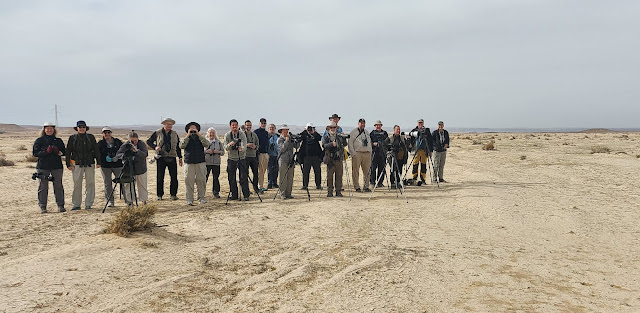
 Male Hen Harrier staging a close fly-by (above), and our lovely group (below)

 Spotted Sandgrouse, Ovda Plains


 Photogenic doesn't do it justice......


