This post covers August and September 2023. See previous posts for earlier in the year.
As has been the norm for some years now, late July signalled the beginning of our Yorkshire Coast Nature Seabird and Whale Adventures out of Staithes on the North Yorkshire coast, which continue through to the end of September. It was another season of great sightings (including many whales, dolphins, quality seabirds and huge Common Scoter passage), but one of the standout highlights was a close-up Ocean Sunfish (a rare species in the North Sea).
Ocean Sunfish right by the boat in this afternoon's @YCNature pelagic out of Staithes, North Yorks! Not often the Minkes play second fiddle..... pic.twitter.com/ScjFirq8EN
For the latter two weeks of August, we headed south to the migration crossroads of Tarifa, the south-western tip of Iberia, where I co-led a Yorkshire Coast Nature trip with our friends Inglorious Bustards. Amity and I arrived a week before the group, ostensibly on a recon, and also to enjoy some downtime in the sunshine.
Griffon Vulture (on the wall outside our lodge front door)
How was it? Well, both weeks were wonderful, and we (and the clients) enjoyed epic raptor migration, beautiful scenery, rustic lodge-style accommodation and unforgettable experiences with a whole range of cetaceans in the Strait of Gibraltar.
(Happily, I'll be leading the same trip this summer, and there are still spaces left.... see here for details)
Little Swift, Andalucia
With plenty of time deliberately set aside for birding, I'd resolved to really make the most of the autumn here on my doorstep, stepping up my (already enviable) local birding opportunities and lapping up as much migration as I could, from August to, well, whenever it finally ended.
Sooty Shearwater, Filey
I hit the ground running immediately on return from Tarifa, greeted by huge feeding frenzies of seabirds, many of which were very close inshore (to an unprecedented degree, in recent times at least) off the Brigg and in the bay here at Filey. Countless thousands of birds were involved, like nothing I've ever seen here, and longer-term locals maintain it was like nothing they'd ever encountered, either - truly breathtaking scenes.
One of many Caspian Gulls....
Several days from 31st August onwards were the most consistently intense, although it continued well beyond that, and periodically intensified again throughout September. The most numerous species were gulls, terns, auks and gannets, with shearwaters and (particularly) skuas often joining the fray.
Common Crossbill, Arndale, 18th Sep - a rare bird on the deck locally!
Terns included many hundreds of Common, several Black and Little, plenty of Arctic and Sandwich, and regular Roseates (with seven on 1st Sep) - indeed, a six tern species session on 1st Sep on the Brigg was a rare occasion here. Both Manx and Balearic Shearwaters joined the throng, and skuas were plentiful - double figures of Arctics were standard, with both Long-tailed and Pomarine dropping in on several occasions (although Bonxies were notably, expectedly scarce).
At least two of the seven plus Caspian Gulls in this evening's huge inshore feeding frenzy by the Brigg here in #Filey. If you can find more, let me know, I'm too tired! pic.twitter.com/6TQkUE00I8
Gulls included many thousands of Herring, big numbers of Common and Black-headed, regular Little (with an outstanding 232 on 3rd), Yellow-legged and Mediterranean, and, fantastically, many Caspians; it was a thrill to pick out a minimum of eight on 31st and multiples on many days thereafter of a species that was a genuine local rarity here just a few years ago.
Screaming, shitting and haranguing during a brief break on a long journey, this Roseate Tern youngster reminded me why I don't have kids 😁 #Filey@ZEISSBirdingpic.twitter.com/oRMWTUGOPH
A Brown Booby, intitally picked up at Flamborough, frequented the bay for a couple of days, too - amazingly flying parallel with me along the shoreline as I took my regular beach run on 4th... which I celebrated with one of many swims in the sea around this time, routinely surrounded by noisy swirls of terns, skuas, auks and gulls.
Best ROAR (Rare On A Run) ever? My usual #Filey beach run had an exotic guest among the tourists today - a Brown Booby, which cut inshore and gave amazing views! Celebratory swim with Arctic Skuas and terns all around me soon followed.... 1/2 pic.twitter.com/F0HnBFrMPz
By the second week of September it was time for the Spurn Migration Festival (Migfest), and what a blast it was. We (Yorkshire Coast Nature) were there as always, to exhibit at our stand, lead walks etc, as well as sponsoring the lecture marquee - we've been proudly involved since day one and it's a real pleasure to see Migfest in such great shape and more inclusive than ever.
Back at Filey, the sea continued to provide, and by mid-month it wasn't just about the inshore feeding frenzies - favourable winds meant lots of very productive autumnal seawatching. The 13th was particularly enjoyable, with six hours producing five shearwater species (as well as a Leach's and more):
The face of a happy birder, who - after years seawatching on the Yorks coast - saw five Shearwater species on the same day for the first time here y'day; throw in Leach's Storm-petrel, four Long-tailed Skuas, Minke Whales & lots more, and it was a good, good day here in #Filey. pic.twitter.com/bqsOgzAfzd
... while the 16th was also very productive, with all four skuas (including four Long-tails), lots of Sooties (over 50) and Manxies, two Balearics, more Casps and a Sabine's Gull over nine hours observations.
Whooper Swan, in off the sea at Bempton, 23rd Sep - one of a pair that were the first to arrive on the Yorkshire coast this autumn
But for some happily productive guiding days at Flamborough and Bempton, the latter part of the month was unremarkable, and dominated by a procession of low pressure systems and strong south-westerlies - but October was just around the corner, and full of promise.....
Common Crane in off the sea at Muston Sands, Filey - 22nd April
This post covers April, May, June and July 2023 - for January to March, see here.
Back from the warm sunshine and and free-flowing migration of Israel to the bone-chilling northerlies and barely stuttering early spring migration of the Yorkshire coast... still, plenty of time for local birding and plenty of work-related birding opportunities, and after a typically slow start, spring picked up pace on the land, on sea, via visible migration (vismig) and also nocturnal migration (nocmig).
Adder, Ravenscar, April
Vismig was particularly enjoyable, with a couple of notable scarcities (Woodlark, Crane) among the varied and welcome fayre of returning northbound visitors, while nocmig was as entertaining and educational as ever, and also included notable scarcities, including Bitterns and a Quail over my Flamborough recorder (see here for the Filey spring summary, and here for the Flamborough spring summary).
Stonechat, Carr Naze, Filey - a pair successfully bred here again last summer
An entertaining (& surprising) arrival here in #Filey this eve - 3 Redstarts, 2 Spot Flys, Garden Warblers, Blackcaps, and at least 32 Willow Warblers (the latter wonderfully varied morphologically!) - all in small area, and in warm sunshine, too.... pic.twitter.com/0Sb6fgFYeE
General migration picked up as April wore on in good time for a typically busy May and June - lots of local guiding and surveying, and off-the-clock birding inbetween. Guiding in May consisted of a series of my Birding Discovery Days at Flamborough and also over the course of a week late in the month at Spurn - both a serious pleasure to deliver, as always - plus a 'Best of Yorkshire' residential group trip and new evening sessions enjoying the breeding seabirds at Flamborough....
Fin Whale, sadly washed up on Bridlington beach in early May
Fantastic sunny day guiding for @YCNature in the Yorkshire forests for our residential group - Honey-buzzard, Kingfisher, Dippers, Marsh & Willow Tits and plenty more - but Turtle Doves really stole the show....
— Mark James Pearson (@Markthebirder) June 2, 2023
... while surveying included two working week-long, very enjoyable combined wader / Breeding Bird Surveys in the wilds of Northumberland, a small wader project in the North York Moors and various ongoing surveys on the Humber as per usual.
Grasshopper Warbler, Northumberland, June
The first week of July saw the Mrs, the old man and I enjoying a lovely, relaxing week on Mull - amazingly, the first time I've been to this beautiful inner Hebridean island, but surely not the last. A stunning place aesthetically, surprisingly rich and varied from a habitats perspective, and lots of fun to be away in such good company.
For three days in mid-July, it was great to back at Birdfair - primarily representing Yorkshire Coast Nature, and also there to rep Zeiss Birding, the School of Birding (more on that to follow) and to do a few public events and the like, inclding a really fun podcast with the lovely Hannah and Erik.
As July ended, so autumn migration and the pelagic season began, and a memorable trip abroad beckoned - more of all that in the next post.
Spoonbill just dropped into #Filey Dams, and it didn't take too long before the breeding Avocets fancied a bit of it.....
One of many Fieldfares along the industrial banks of the Humber on our January surveys. More here.
This post covers January to March 2023
The year began fairly quietly, with January involving lots of survey work on both banks of the Humber and bits of guiding up here on the coast, but was soon to become much busier. A full month in the USA for much of February and the first week of March, visiting family and friends across New England, was a joy:
Red-breasted Merganser, Maine
An initial few days back at Amity's homestead in the woods of Western Massachusetts was followed by a memorable trip to see our dear friends Kat, George and Indigo on the coast of Maine....
Steller's Sea Eagle, Maine. An unforgettable adventure - read the full story here
Memorable for many reasons, not least the (still) unbelievable timing - it's hard to undersell just how lucky we were to cross paths with a Steller's Sea Eagle, just twenty minutes away, on what turned out to be the last day of its brief visit to the area.... outrageous!
Post-Steller's aftershocking
After Maine, we journeyed down to the far north-eastern coast of Mass, specifically Plum Island, where we spent a fine few days with the American Pearson clan. As it happened, it was very birdy, both on- and offshore - lots out on the waves, and plenty of action on the saltmarsh, too.
White-winged Scoter (above) and North American Horned Lark (below), Plum Island
From there, back into interior Massachusetts, where it was all about the family. Birding-wise, there were plenty of classic winter New England species in the garden and on local walks, of course, as well as a few excursions a little further afield (including, for example, to the nearby Quabbin Reservoir).
Dark-eyed Junco in the garden, Warren, Ma.
While we were in States, at the end of February I completed my #ASwift1K challenge - 1000km (600 running, 400 cycling) over twelve months, to raise money for the brilliant Sheffield Swift Network.
Bald Eagle, Quabbin Reservoir
Happily I raised in excess of £4000 (thanks to a great many generous contributions), and just to add a bit of drama, I only just completed my target, with a broken toe (sustained in Maine a week earlier) and with a killer cold (courtesy of our otherwise perfect nieces). I won't forget those last runs in the ice and snow of Greenfield in a hurry....
Lichenstein's Sandgrouse, Israel
Back home for ten days or so in mid-March (and more surveying) before our next trip, this time for a wonderful fortnight in Israel. For the last week of March and the first week of April, we were there for Champions of the Flyway and to spend some downtime further exploring and enjoying this beautiful, bird-rich country, which I've had the pleasure of visiting many times in recent years.
Male Common Redstart, Ofira Park - classic Eilat urban birding scenes
There were a great many highlights (as is always the case when we're there), but some included:
Guiding for the Eilat Birds Festival, particularly on one crazy day of overwhelming migration in one small fertile patch of the desert at KM76 - enough birds to last us all year and beyond back in the UK.....
Hen Harrier, KM76
The joys of Eilat, which included some of the best urban birding imaginable, some fun nights out, an insane encounter with a Bonelli's Eagle, and most memorably, multiple, blissful snorkelling sessions in the Red Sea.....
Bonelli's Eagle, Israel
Running the comms and team support for the always-wonderful Champions of the Flyway - a joy, particularly after the upheavals of the previous few years, to have our international community back together and raising vital funds (this year for Red-breasted Geese); Spending lots of quality time with our dear friends the Perlmans (and lots of birding with brother Yoav);
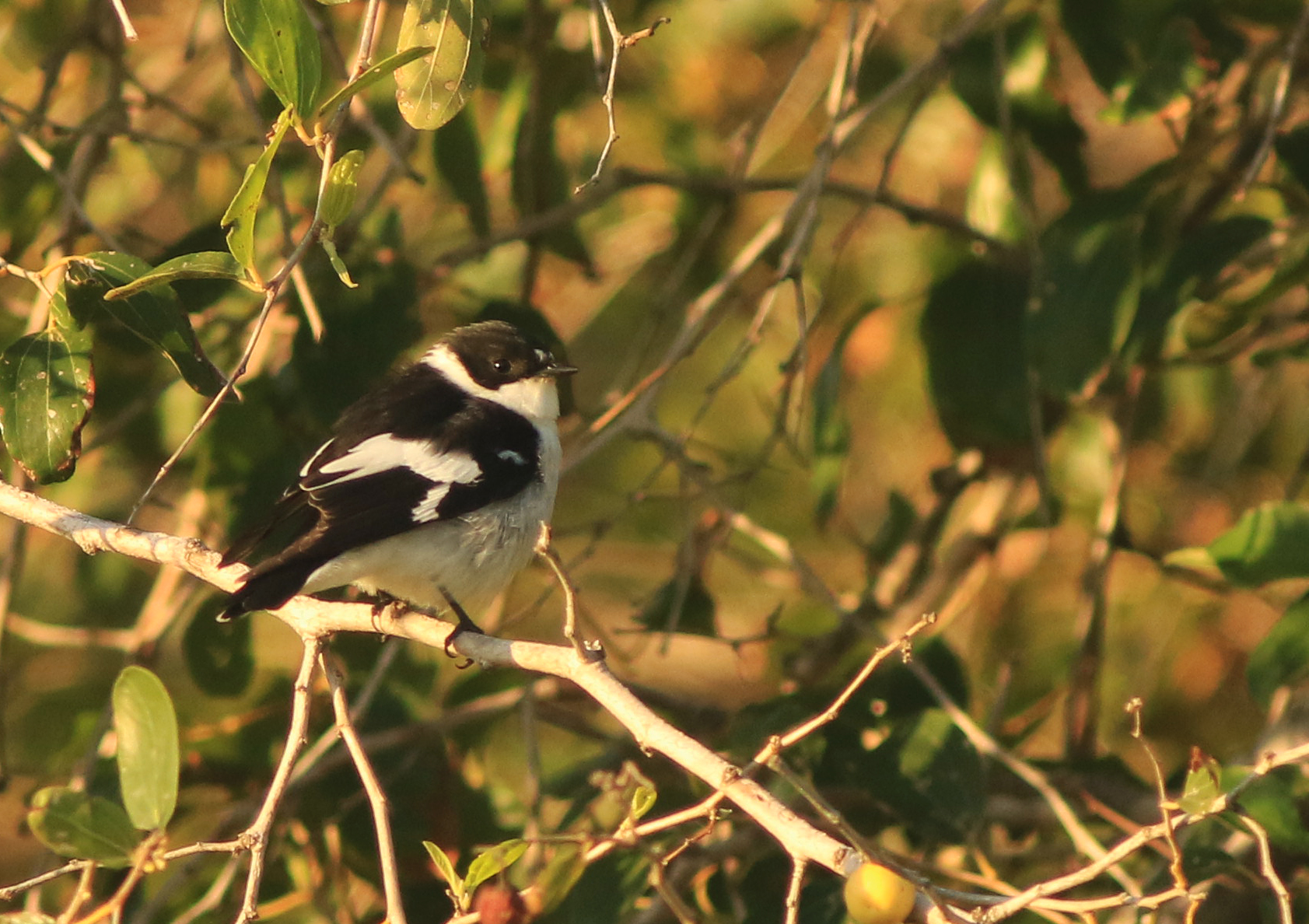
Semi-collared Flycatcher, Ashkelon
Exploring corners of the country I'd never ventured into before, including the mountains and the far north; and birding and staying with our good friend Nadav, and lapping up the birding joys of his backyard, the Hula Valley, with him.
Watching displaying Demoiselle Cranes in with the commoners with Nadav, Hula Valley
A contrasting, friend-, family-, travel- and bird-filled first part of the year, and back in position in good time for spring to kick in back home.
Most of the day free, and so into the field locally for the first time in a while. I started on the doorstep here in Filey, where single Lapland and Snow Buntings were on Carr Naze, and Great Northern Diver, a couple of Common Scoters, and plenty of auks and Fulmars were off it; I then continued into the Top Fields and had a good patrol of the (somewhat waterlogged, very muddy) stubbles, where the passerine activity continues to be excellent.
Waxwings, Martongate
Conservative estimates of 53 Snow, 18 Lapland, one Corn, eight Reed and nine Yellowhammer made it a five Bunting session, as well as 160 Skylarks, 15 Rock Pipits, 40 Meadow Pipits and 45 Linnets - a real bonanza by recent standards, and I'll continue to check it as long as it holds good numbers of birds (who's to say the ShoreLarks aren't still around, and/or a rarer visitor might not join the flocks?).
From there, a fifteen-minute drive to Martongate, where a small flock of Waxwings had been reported (Ta, Johnny) - unlike a few other local attempts of late, this one was a quick and easy joy.
Quality local winter birding.
Snow (above) and Lapland (below) Buntings
Reed Bunting (above), mixed bunting and lark flock (below)
Back north last night after a lovely few days in Bristol with old friends, and back to work as of this morning on the north bank of the Humber near Saltend. A mercifully calm, uneventful day weatherwise, and bird-filled, as it so often is here on the riverside - hundreds of Lapwings, Curlews, Pink-feet, Wigeon, Teal and plenty more.
Please use headphones for the audioclips. For a summary of Filey results in the first half of the year, see here.
As usual, I ran two nocmig recorders in Filey during the season - an mp3 recorder from my study window here in the town, and an audiomoth up on North Cliff. The former's employment is always opportunistic (depending on conditions, availability, and waiting for the gull colony to wind down in early-mid September), and this autumn, the latter was too - a combination of uninspiring conditions and equipment issues led to a reduced recording presence this time round.
So how was nocmig over Filey in autumn '23? Those aforementioned uninspiring conditions were unfortunately dominant (and at times seemingly endless), but there were various highlights, plenty of good nights, and a couple of great nights (with one in particular standing out).
Filey Town
A total of 13 nights during September were quiet, with only a handful of species - Knot, Oystercatcher, Moorhen, Snipe, Dunlin, a few Golden Plovers, Bar-tailed Godwit - registering before a small wader movement on 26th included a flock of Sanderlings, several flocks of Dunlins and a Ringed Plover, followed by the first skein of Pink-footed Geese over on 29th.
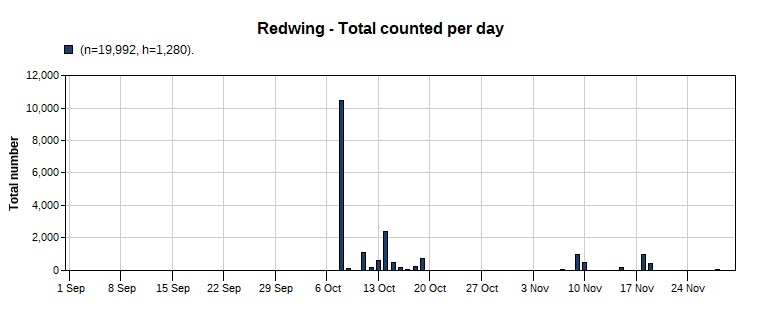
Another 13 nights were covered in October, with - after weeks of relentlessly blocking conditions - an unprecedented flood of incoming migrants on the night of the 7th-8th. It was a nocmig night like nothing I've ever seen or heard before, which (after some time-consuming but fascinating analysis) smashed UK and European records on Trektellen for both Redwing and Song Thrush registrations. For a full summary, with context, audio and images, there's a dedicated post over here - The Big Thrush Night, 7th Oct '23.
The following night saw plenty of quality migration, too, with flocks of Knot, Sanderling, Dunlin and Snipe among others, while passage continued in fits and starts for the rest of the month. Species diversity was fairly modest and expected, with e.g. Snipe, Pink-feet, Black-headed Gulls, Dunlin and Golden Plovers, plus Bar-tailed Godwit on 11th and always joyous flocks of Whooper Swans on 11th and 13th; thrushes continued to dominate, however, with Redwings recorded throughout (and another big night of 715 on 18th) and a Ring Ouzel on 22nd. A one-off night in November (8th) registered a handful of expected species in the shape of thrushes and geese.
Filey North Cliff
Coverage in July was almost constant, and the first week of the month featured Curlews, Little Ringed Plover, Redshank, Oystercatchers and Golden Plovers, with the autumn's first Whimbrels on 10th, the first Common Sandpiper on 11th, and (unusually) a Swallow on 12th; a similar suite of species continued throughout the rest of the month.
Two flocks of Arctic Terns (with a further flock on 6th) and three Redshanks kicked off a muted August on 3rd, with Redshanks a regular feature of the ten night's total recording for the month. Sandwich Terns (8th) and Common Terns (10th) followed, with a further three flocks of the latter on 15th, when a Green Sandpiper also registered; the following night saw flocks of Whimbrel, Turnstone and Knot overfly the recorder, as well a single Greenshank.
Just six nights recorded in September featured Curlew, Dunlin, Oystercatcher, a flock of Turnstones (3rd), and Golden Plover, Redshank, and the autumn's only Spotted Flycatcher on 2nd. Just four recorded nights in October, consecutively from 7th, scored highly, principally thanks to the huge thrush arrival on the first of those nights; while not quite the tally as the aforementioned Filey town count, it was still huge, constituting the fourth highest-ever European count on Trektellen.org.
The 7th was a good night in general, with eleven species audible through the rain and wind - who knows what else (and how many other thrushes) were disguised behind the messy spectrogram.....
other species on subsequent nights included Pink-footed Goose, Common Scoters, Robin, Water Rail, Golden Plover and Skylark.