Champions of the Flyway!

Sunday, December 19, 2021

Winter guiding on the Yorkshire coast

Happy clients enjoying close-up Purple Sandpipers in the Filey sunshine 

As of yesterday, my sixth and final Winter Birding Discovery Day of 2021 - and my last tour of 2021 - brought what was a wonderful year of guiding to a close. I'll look back at all the year's guiding adventures in more detail here shortly, but these coastal winter days - only introduced last winter, and then sadly disrupted by plague restrictions - have been a particular pleasure.
More happy faces after (even closer) Snow Buntings

It's a different bag to guiding in other seasons, and a different approach is required; shorter, colder days with a higher chance of less pleasant weather means working even harder than usual to get the most out of them, and it's a challenge I've especially enjoyed, helped in no small part by really lovely, hardy, up-for-it clients.
Sunrise over Scarborough South Bay - not a bad way to start a tour.... 

The locations involved vary, and depend on tides, forecasts, and local knowledge re: where the good birds are; theoretically we've the choice of various productive venues between Bridlington and Ravenscar, but for these tours, we've concentrated on Filey and Scarborough, both of which payed out wonderfully.
Very friendly Sanderlings against the Badlands backdrop of Bay Corner...

The aims of the days include focusing on a suite of iconic winter species against evocative local backdrops, all of which have their own unique stories to tell, and this always involves birds which I'm particularly passionate about; it's also about giving our guests a specialist local insight into where is best and why, as well as plenty of time spent on fieldcraft, ecology, migration, and habitats.
... many enjoying a fish breakfast 

It's easy to forget that locally, some of our most iconic and popular species are almost exclusively winter visitors, or at least easiest to track down in the winter - these include our often wonderfully tame local shorebirds (Purple Sandpiper, Sanderling, Oystercatcher etc), bay-dwellers (Great Northern and Red-throated Divers, grebes, Shags, Eiders, Scoters etc), Harbour Porpoises (so much closer and more reliable in winter), and coastal passerines including Snow Buntings and Rock Pipits.
Porpoises to the left of me, Peregrine to the right - here I am....

We were often blessed with benign (or even lovely) weather - maybe it's statistically not as likely to be as poor as my pessimistic inner forecaster tells me? - and packed in as much as we could, resulting in effectively dawn to dusk birding; in addition to a lunch break, there were, of course, breaks for hot chocolate and donuts as required....
Turnstone flash mob at Scarborough harbour 

Depending on the tide and therefore access out to the Brigg and Bay, we either began or ended here at Filey, with consistently great results. Divers were a constant (and often close); Purple Sandpipers and Sanderlings entertained us on each day (and were often very close), with other waders including Oystercatchers, Redshanks, Knot, Curlew, Dunlin and more; Great crested Grebes, Eiders, Scoters, Shags, Guillemots, Razorbills and other sea-dwellers bobbed around just offshore; and Snow Buntings - never a given, and often unpredicatable - were very kind indeed, usually to with a metre or two....
Spot the Snow Buntings on Carr Naze 

In stark contrast to the wild, untamed beauty of the bay and Brigg, Scarborough seafront is equally special, and - for a birding and wildlife experience - it's equally unique; where else can you watch porpoises frolicking incredibly close on a sea peppered with various bird species in one direction, under the watchful eye of accommodating Peregrines in another, and Turnstones running around (literally) at you feet in another, all against the backdrop of the sandstone cliffs, the picturesque harbour, the funfairs and the castle?
The end of some great days - moonrise at Scarborough.... 

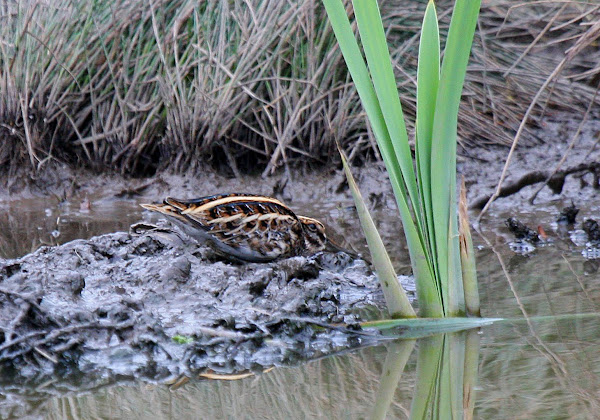
Other excursions can be often be factored into our Winter Days - these included calling in to see the Med Gulls at Holbeck, trying for Jack Snipe at a specific spot in Filey (both successful), and having fun with our thermal imager at dusk at the Dams (and we can adapt plans on the day to cater for requests and latest news) I'm back out in Jan and February, and if you want to join me, book here!
.... and sunset at Filey

Wednesday, December 8, 2021

Nocmig Update - Autumn '21 (Filey)

Jack Snipe - a new addition to the nocmig list in November (see soundfile below) 

It's been a while since my last Nocmig round-up (see here) - which kind of tells its own story - but in the interests of consistency, here's a summary of results from my Filey recordings over the autumn, covering September to November inclusive. I ran the AudioMoth up on the North Cliff for most of the period (although I lost a couple of weeks due to tech/human errors); in contrast, it took until late September for the gulls to reach anything like tolerable levels on my street, and so recordings from the study window were confined to more promising nights in October when I happened to be around (totalling 14 through the month).


(Recordings are best listened to with headphones) 

North Cliff 
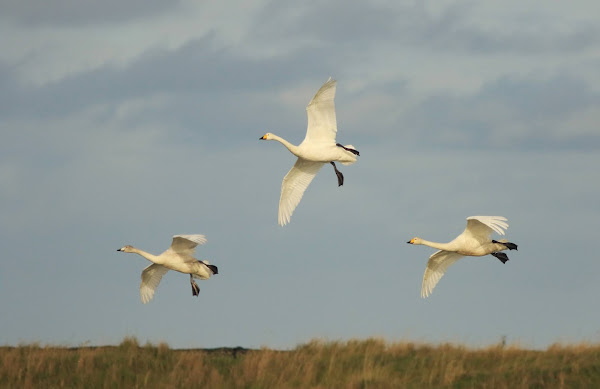
After an encouraging start to the autumn migration season through August, pickings were pretty slim in September, with low diversity and abundance. Waders continued to provide the majority of registrations, with regular Curlews, Oystercatchers, Dunlins and Golden Plovers, plus the odd Common Sandpiper and Whimbrel. Once again, all three tern species put in appearances at the start of the month; towards the end of the month, meanwhile, the first passerines were recorded in the shape of Song Thrush, Robin and Skylark, and the welcome yapping of many Pink-feet (from 23rd) was topped only by the beautiful trumpeting of Whooper Swans (on 29th).


October was also pretty quiet overall, with most nights registering only a few, expected species; there were exceptions, however, with eleven migratory species on the night of the 8th, the most numerous of which was Dunlin, with flocks and individuals throughout the night. A late Arctic Tern on 10th coincided with diurnal records around the same time, while the first of several strong Redwing influxes occurred on the following night (321), followed by 119 on 12th. The latter part of the month was a little more productive, with a better showing of expected late autumn migrants (including thrushes, Curlews, Golden Plovers, and Whooper Swans), but the big event was the regularity and huge numbers of Pink-footed Geese - many flocks on many nights, often consisting of many, many birds.  


Despite only running for 12 nights (due to poor weather and tech/human error), November was arguably the most prodctive period (in parallel with last year). Small numbers of expected late autumn species were the norm, but replaced by far better results and some excellent nights when the conditions finally became encouraging. Consistently double-figure counts of Redwings became 419 on 13th, a night which also featured 112 Blackbirds, a surprising 34 Fieldfares (by far the least vocal of the thrushes on nocmig), Dunlins, Song Thrushes and a bonus small flock of Black-tailed Godwits.


The next two nights were also pleasingly productive (again because of, finally, beneficial conditions), with 255 Redwings and 121 Blackbirds among a good cast on 14th, and an even better selection on 15th (including Golden Plovers, Snipe, Skylark, Wigeon, thrushes and huge number of Pink-feet), headlined by my first nocmig Jack Snipe, a species I've been hoping for for some time. So, a late flurry and happy ending to what was a pretty muted nocmig period overall over North Cliff.


Filey Town 
As mentioned, noise pollution (gulls and humans), conditions (mostly lousy) and availability (I was away for much of the period) were big factors in the reduction of nocmig recordings from the study window this autumn, but even so, there were pleasing results. Wildfowl included lots of Pinks, a few Whoopers and my first Common Scoters in many months, passerines included Dunnock and Skylark, local owls were represented by nightly Tawny rackets and yet more evidence of Barn Owl crosstown traffic, and a good arrival of Redwings on 11th (197) preceded the best count of the autumn on 12th, with 542, and 85 Blackbirds, among other migrants.


Full nightly counts available here. Flamborough autumn nocmig summary to follow (when I've gone through seven weeks of recordings....!)

Tuesday, December 7, 2021

Aukward

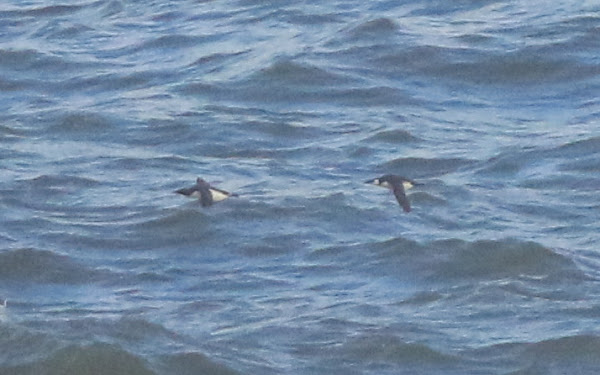
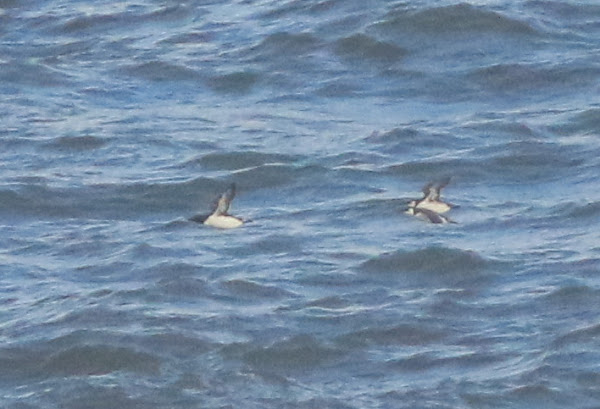
Auk sp (left) with Common Guillemot (right), Filey, 28th November 2021. From this photo, subjectively, the bird in question is: bigger, and much more bull-necked than the accompanying Common Guillemot; shows white flanks, which clearly extend well up onto the upperparts at the wing-base (a supposedly nigh-on diagnostic feature of Brünnich's, and also Razorbill, which it isn't); has clearly protruding feet at the rear, and - in direct comparison to the right-hand bird - a obviously more rotund, 'rugby-ball' profile overall. Note that the bird is in full or nearly full breeding plumage - neither a plus nor a minus (with at least one sum-plum Brünnich's reported up the coast the same day, but loads of Commons exhibiting this plumage too). Compare with photos of mooted and even seemingly 'accepted' Brünnich's Guillemots on social media and the bird news services websites in recent days - based on one or two images, you could argue this is in some respects at least as good a call (with better quality images) than some of the latter; but how 'acceptable' would it be, especially if based on one or two 'favourable' images and a solid description? 

As many birders (especially those with access to the east coast) will be more than aware, there's been an unprecedented number and/or claims of Brünnich's Guillemots from coastal watchpoints in recent days, almost all involving that most controversial of sightings, the seawatch fly-by; particularly controversial in this case, where historical fly-by claims of this species are still very much the subject of ongoing debate.
Arguably looking bigger, darker above, and showing more of a rugby ball profile than its companions

More rarity-focused readers will have seen the various photographs of 'Brünnich's Guillemots' - either claimed as definite, mooted as possible/probable, and/or seemingly judged as acceptable - online over recent days, too, which is why I thought this post might be of interest. I'm no expert, but having done a hell of lot of seawatching over the years here on the Yorkshire coast, I'm acutely aware of how many interesting (sometimes very interesting) fly-bys one has to let go - seawatching, more than any other birding discipline, isn't for the faint-hearted where potential rarities are concerned, being inately infused with the regular frustrations of probables, could-have-beens and likely-weres.
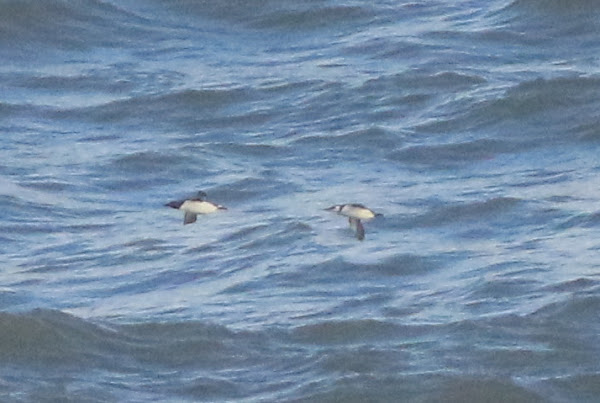
Again, overall the left-hand bird looks bigger, darker, and - subjectively - somewhat blunt-ended / stubby-billed. There's a limited amount of dark colouring on the otherwise pale underwing, which could easily be interpreted either way - a plainer underwing is a percieved feature of Brünnich's, and yet a cursory web search of them in flight reveals plenty with dark feathering and shadowing within this range. 

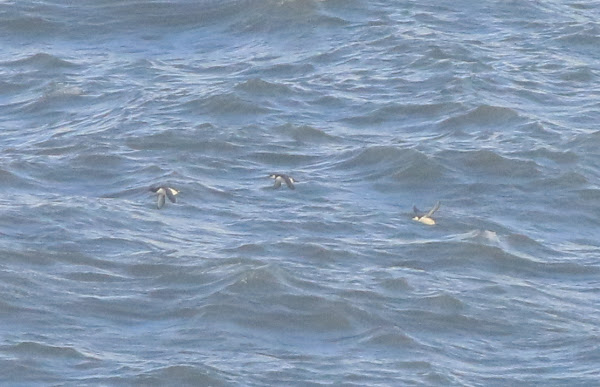
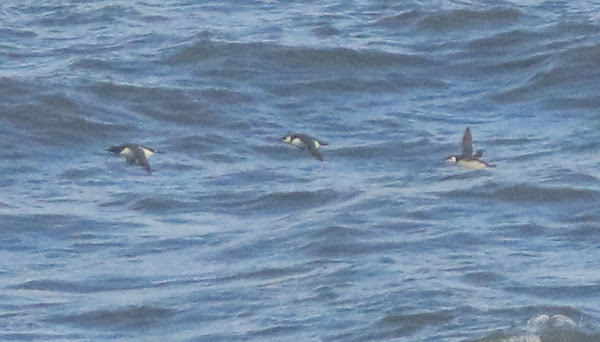
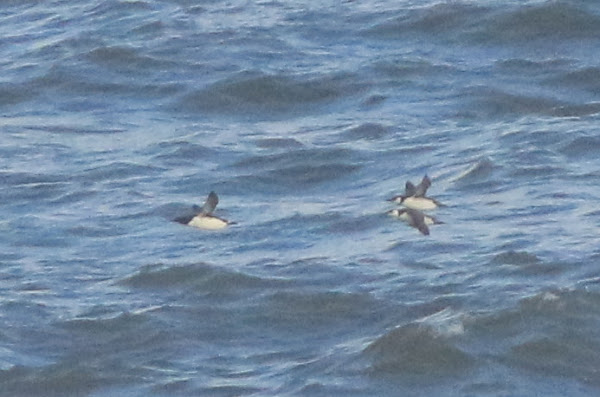
With that in mind, I thought it might be worth posting about a bird I photographed last week here at Filey - on the day of the majority of Brünnich's claims, the 28th November. I was in the middle of a lengthy seawatch, with the species very much on my radar (following birds in the eastern North Sea, and then Norfolk, in preceding days), when a bulky, dark, stubby-looking auk rounded the Brigg, heading north with two winter plumage Common Guillemots - and so I grabbed the camera, found them in the viewfinder and fired off a series of shots, shown here (unedited but for cropping).
Still arguably looking big, and rotund, in comparison with its buds, and showing extensive white on the flank sides up onto the upperparts. But, is the bill looking a bit long and spiky? It could easily just be a photographic anomaly, however - but then, so could several other pro- features mentioned.... 

Not the greatest of views, but not the worst, either, particularly of a fly-by seabird, and I umm'ed and aah'ed over it throughout the watch; back home, I reviewed the photos on the big screen, and still felt uneasy enough to send them to various birding friends for their opinions. The replies were equally inconclusive overall, with some stating it looked good for Brünnich's, some thinking it was better for Common, and others on the fence.
Still big and dark, still notably pot-bellied, but what about the bill - or at least the (potentially misleading) photographic impression of it? Subjectively too 'pointy'? But, if the photo were of poorer quality, the bill would likely appear less defined, and therefore more Brünnich's-like. Insert shrugging emoji here (and after all the captions, for that matter)

The relevant features are, subjectively, addressed in the photo captions above and below, but the bird (and the photos) highlight various questions as to what constitutes an acceptable fly-by Brünnich's Guillemot, from this (or any) period: How many photos are required, at what level of quality and at what kind of distance? From how many angles? Should they involve comparable species? There are other issues involved, too: how much of an advantage is it to have a (tough to ID, often brief, often in far-from-ideal conditions) seawatching fly-by like a putative Brünnich's multi-observed (as opposed to single-observed)? Some would say it's important; others, not so much, especially when factoring in the potential conformation bias of a communally exciting moment. And what about the even more loaded and fraught issue of non-photographed claims? How much emphasis is weighted towards the quality of the description, or the reputation of the observer(s), or the length / distance of the views?
Also worth pointing out - there were plenty of examples of darker, 'Northern' Common Guillemots on the move during the day and indeed week - lots of variation evident within that species

A minefield at best, and a shitstorm at worst - who'd be on a rarities committee when all these claims come up for assessment....?! Note that I'm not doubting or judging any recent (or historical) claims or sightings, but just throwing this in the mix for reference. Note also that I'm lucky enough to have already found a Brünnich's locally, in Filey Bay eight years ago - at the time, the first live record for mainland England (see here) - so there's zero envy agenda at play here....!
I'm sticking with you.....


Sunday, December 5, 2021

Spurn, Nov '21

Short-eared Owl - amazing views on many days

After our hugely enjoyable and successful week's guiding there in late October (see here), we returned to Spurn for another five day stint soon after - Rich again with a week-long group, and I with a series of five Birding Discovery Days, for different clients (a maximum of four) each day.
Whooper Swan - the quintessential late autumn migrant wonderbird

Planned (and fully booked) for the same time last year (but beaten by plague restrictions at the last minute), this became our first YCN November adventure at what is arguably the UK mainland's premier Bird Observatory - and what a memorable week it was.
Woodcock - the other quintessential late autumn migrant wonderbird

There are many advantageous factors involved when guiding at Spurn, but a couple of the most important ones are: how every day is genuinely unique - and always productive - depending on conditions, and how great it is to be able to take in the key locations on foot, without having to drive.
One of thousands of Blackbirds spirlling up into the ether at dusk, beginning the next stage of their migrations

With the invaluable help and assistance of various friendly locals, we're able to maximise every hour of daylight to get the most out of all the nearby sites and habitats, which is an essential part of my Birding Discovery Days generally - as well as great birding, a unique day in the field and a lot of skill-sharing, they provide an insider's crash course into the places involved. So whether it's Spurn, Flamborough, Filey or any other of our chosen locations on the Yorkshire coast, our clients leave with 'the knowledge' of exactly where to go, when, why and how.
The most underrated of scarcities - a stunning Siberian Chiffchaff (the first bird I found after breakfast one morning as I walked out of the Obs...)

We had wildly different conditions every day - from becalmed and mild, to bone-chilling and blustery, to stormy and wet, to sunny and clear - and, as mentioned, the real beauty of the place is how every day provided a unique migration experience. Regarding those visceral, first-hand migration memories, there are too many instances to list here, but it's worth pointing out that fortune favours the brave: the days that looked (and felt!) most challenging on the forecasts often provided the most thrilling birding experiences.
Whoopers in the last of the light over Kilnsea Wetlands

My point? There is no such thing as a 'normal', generic day on our Birding Discovery Days at Spurn - each is unique, and each is always full of the wonders of migration.
Bramblings - fantastic numbers arrived during the week, including many in off the sea (as with this flock)

If you'd like to join me in autumn '22, our dates are fresh up on the website - book here and I look forward to seeing you!
Woodcock, Curlew, incoming Redwings
Siskin, Long-eared Owl and Brambling - all in off the North Sea
Dusky Warbler, which turned up in the net as Paul was giving our group a ringing demo!
Short-eared Owl, Snow Bunting
Brent Geese, including the local celebrity blonde bombshell
Spotted Redshank at Kilnsea wetlands

Friday, December 3, 2021

Quendale Nocmig, Shetland - late Sep '21

After a lengthy delay (it's been a busy time....) I recently had the chance to review a few night's nocmig recordings from our trip to Shetland. It was too windy and/or wet for anything more than a couple of night's recordings, but still, I'm glad I did.....
Quendale, a small farm near the very south-westerly tip of Shetland....

I set the audiomoth (a small, pre-programmable recording device less half the size of a mobile phone, which runs on three double A batteries) and left it lodged in a drystone wall at Quendale, one of our favourite sites (and scene of impressive daytime vismig). Even the two salvageable nights were pretty windy, and my expectations were low. The second night (30th Sep) produced 43 Redwings, Grey Heron, Song Thrush, Blackbird, Common Snipe and Golden Plover in between lengthy periods of distortion from wind interference, but it was the night before - 29th - that really made it worthwhile.


... and the position of the recorder (black arrow), wedged into a drystone wall next to the derelict barn 

Redwings, Skylarks, Snipe, Golden Plovers, Curlew, Blackbirds and Oystercatcher were all clocked migrating overnight, and a huge, excitable collection of more than 600 pre-morning-flight calls of Chaffinches and Bramblings around dawn was a lovely bonus. But the commonest species (on number of calls) during the night-time proper - totalling eleven calls, spread between 2307 and 0122hrs?


Yep, Yellow-browed Warbler! Amazing, and totally unexpected. Interestingly, the calls are all very much within the middle period of the night - many hours from either dusk or dawn - and are well spread; specifically, at 2307hrs (three calls), 2314hrs (two calls), 2319hrs (one call), 0003hrs (two calls), 0044hrs (two calls), and 0122hrs (one, very clear and close, call).


There's a small stand of pretty crummy, gnarled sycamores nearby (hence the finches morning-flight calls), but otherwise it's all open ground; and indeed on our visits there during the days, we only ever saw Yellow-browed Warblers - a grand total of two - some distance away, in low vegetation / iris beds in the burn. The last call, especially, sounds very much like the bird was close(r) to the recorder. Perhaps of interest, the drystone wall that housed the recorder itself creates might be described (and used) as a kind of stepping stone flightline between the (substantial) habitat just to the north in e.g. Brake, and the SW tip of the islands.


So - one, two or more birds? All from the Sycamores - unlikely, owing to the distance and the prevailing northerly wind - or from mobile birds, or both? From roosting, or actively migrating bird(s)? Impossible to know, but fascinating to speculate - and the last species I expected to rank as 'commonest' (on number of calls) on that night's nocmig recording....

Tuesday, November 30, 2021

The Highlands - November '21

Golden Eagle - always a privilege....

After the plague just beat us for our regular week there late last year, we finally, happily returned for our annual residency at the wonderful Grant Arms Hotel in the Highlands this November - and what a week it was.
Treecreeper in Caledonian pine forest (Cresties too, but they were camera shy this year)

Fortunately for us, the BWWC at the Grant Arms have invited us up for several years now, and as regular readers will know, we really love it up there - wonderful birds and wildlife, breathtaking landscapes, tranquility, epic scenery, and good friends.
Regular readers will also know how much I love seaducks, and so it's kind of a perfect match that I should be asked to lead excursions and give evening talks for their Seaduck week each year. The stars duly aligned to provide wonderful conditions and experiences, with the good folk on our over-subscribed excursions enjoying everything from displaying Long-tailed Ducks, Goldeneyes and Velvet Scoters to Goosanders and Red-breasted Mergansers alongside each other in stunning locations.
Snow Geese and Brambling at Loch Spynie 

Otherwise, we revisited various favourite spots and explored new ones, had a scream with good friends Simon, Mike and Sue (as well as Dave and various other hotel guests), and generally lapped up the opportunity to decompress after a very manic and full-on autumn.
Coal Tit, Siskin and Red Squirrel in the forests
Black Grouse, momentarily spooked from their entertaining and comical lekking
Running in Anagach - still doin' it for the doves (see here) 
Flocks of Eiders (above), and - magically - Siskins (below), the latter arriving in off the sea from Scandinavia in droves, low over the waves