Days five, six and seven of our Scottish adventure saw us immersing ourselves and exploring the Highlands at a slow, gentle pace, from the Cairngorms to the valleys, lochs and the forests, in warm sunshine and perfect conditions.
A few from our two YCN pelagics out of Staithes this weekend - Common Scoters (big numbers on the move), Gannets fishing, Fulmar, Guillemot and Razorbill young, juvenile Mediterranean Gull, Harbour Porpoise.
Day Four saw us heading north from Grantown, to the coast (via an impromptu diversion to marvel at some pretty wonderful Pictish carved stonemasonry), and more specifically, to Spey Bay. Again warm and soon once again sunny, we strolled the shingle banks of the estuary and beach - I in the company of a very accommodating flock of Sanderlings (above and below), Amity 'beach-cleaning' with a plastic shark grabber she found on the strandline. It's good to have different interests.
The bay and estuary were packed with birds, including Ospreys and Little Terns (pictured)
Another diversion for a picnic lunch, this time to Rothiemay neolithic stone circle, hidden in the countryside further east. After falling asleep there for a while, it was vaguely disappointing not to wake up in either another time or universe, but otherwise, the stones were impressive.
Back near base for the afternoon, and a walk in nearby Anagach forest with our friend Sue and companion Loki; after catching up with Simon (Pawsey - another local good friend and highly recommeded wildlife guide for Cairngorms Birding), it really feels like it'd be easy to settle up here. (Huge donations towards house / land purchase gratefully accepted).
We've just returned from a sunny, sublime and wonderfully relaxing week in and around the Highlands of Scotland, one of our absolute favourite places on the planet, and an area with many good memories and adventures for us in recent years.
Day one - the drive up the coast and over the border, and the evening in Eyemouth (above)
Day two - much of the day exploring the beautiful St. Abb's Head - stunning scenery, seabird colonies, wildflower meadows full of butterflies and more (above), before the drive up into the Highlands and Grantown-on-Spey, and our base for the week
Day three was spent returning to our favourite valleys (above) - which we're very familiar with in winter, but not in the height of summer - with swathes of wildflowers, ultra-lush greenery, both Golden and White-tailed Eagles (below) and thankfully not that many more humans than in November; remote, peaceful and perfectly decompressing.
A day's surveying in the post-apocalyptic industrial wasteland of the Killingholme area dominated by Avocets, and not just their flightlines and movements... in fact, a fair proportion of the time was spent in lollilop mode, shepherding chicks away from turning lorries, and shepherding (wholly sympathetic) lorry drivers away from chicks.
Interestingly, the well-developed but still flightless / helpless youngster pictured below not only didn't bother to run and hide, but actively 'fed' on the car park, swishing its vaguely comical, partially-developed bill from side to side on the concrete. Young Avocets can (and must) feed themselves - indeed, the younger chick on the Pits (above) was doing a fine job - but quite what food could be found by swashbuckling across concrete is anyone's guess.
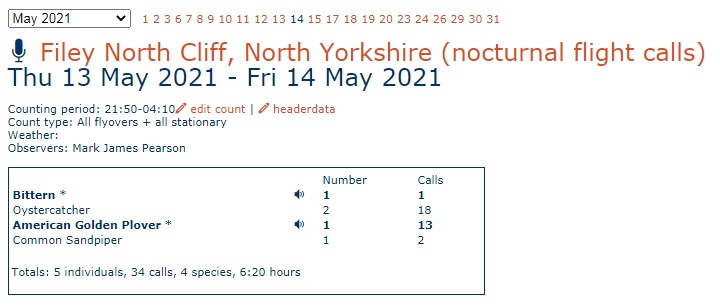
The already weird spring of 2021 gets weirder (and even better). It's increasingly hard to keep up, I know (for me at least), but a series of calls I recorded at 2317hrs on 13th May at my North Cliff nocmig site here in Filey was, after extensive investigations, nothing less than an American Golden Plover.
Rewind back to the 14th May, and after retrieving my recorder and checking through the content, I was very happy with the night's work - a Common Sandpiper, a couple of Oystercatchers, and nocmig gold in the form of a Eurasian Bittern (locally less than annual) over at 2244hrs. About half an hour later, a series of distinctive and (thankfully) very clear calls - presumably from a wader, but not instantly recognisable - registered, and sounded interesting enough to take further.
As mentioned recently, I'm lucky to have the wisdom of those far more skilled and experienced in such things than I to call on, and my go-to for anything out of the ordinary is always Magnus (Robb); I've learned more, and had more help, from Magnus in these first stages of my nocturnal sound recording journey than I could've ever hoped for. I sent it to him with a comment down the lines of 'this is probably an aberrant sandpiper or plover, but....', to which he immediately suggested American Golden Plover. Yikes....
Heading for the wonderful library of online recordings on Xeno-Canto, I spent a good while comparing, as well as digging further into possible commoner explanations, but kept circling unavoidably back to AGP...
As always in these situations, and as previously mentioned often in nocmig blog dispatches, caution is paramount when dealing with potentially rare nocturnal flight calls, and the procedure goes something like this: If it's interesting, investigate via available resources (Xeno-Canto, the Sound Approach, etc) and discuss with the local group; if it's still interesting and unresolved, get expert opinions and investigate more, including posting on Xeno-Canto and Trektellen for comment; if expert opinions concur, seek further expert opinions if necessary, always of course with an emphasis on ruling out an aberrant commoner species.
Which, happily, is how the above played out over the last few days.
While emailing about the Black-crowned Night-heron last week - I know, keep up at the back - Stanislas (Wroza - European sound recording expert) asked if I'd got any further with the potential American Golden Plover, which he and James (Lidster), as well as Magnus, both felt was spot-on for AGP; just the nudge I needed after a very busy few weeks, and so I sent further emails to various learned contacts.
All of whom, to my surprise and joy, independently verified the series of calls as a bolt-on, unequivocal American Golden Plover. Included in the above were resounding verifications from Michael O'Brien and Quentin Dupriez (renowned experts on either sound of the pond), who were all (crucially) able to rule out any aberrant commoner alternatives. And with that, it was time to edit that trektellen entry....
June is very much a transitional month for nocmig, with most of the traditional spring migration having ebbed away, and early 'autumn' passage (particularly of waders) still not showing much of a pulse; with that in mind, I expected very little, revised my effort/reward ratio accordingly, and hoped perhaps for the kind of random overshoot* that makes it all worthwhile.
Grudgingly I had to mothball the house recorder until the after the last of the satanic Herring Gulls finally f..., f...., fledges later in the season, but the Flamborough recorder was still active on most nights, and the arrival of an Audiomoth (see here) to cover the Filey North Cliff site introduced a much-needed convenience to local coverage - coverage that, without it, realistically wouldn't have happened this month....
... and so it was all more rewarding to scroll through yet another pretty blank night on of the 22nd/23rd, only to stumble upon two flight calls at 0141hrs (one clear and loud, one faint and later) of nothing less than a Black-crowned Night-heron. More on this dumbfounding occurrence here, save to say that it's my rarest nocmig record to date in fifteen months efforts here, overshadowing such treats as Stone-Curlew, Dotterel, multiple Bitterns, Yellow-browed Warbler and more.
Otherwise - who cares? Only kidding.... there were a few other notables, as follows: Flamborough's stand-out record was a Redwing post-dusk on 13th, which called multiple times before spiriting away - an extremely late record that, after last month's Filey records, amazingly reduces Redwing-free nocmig months to July and August only. Otherwise, a few waders and rallids (including a handful of Water Rails) were pretty much as good as it got.
It was a similar scenario up on the North Cliff, with a few waders (including Grey Plover) and a handful of rallids (including Water Rails), plus the odd Gadwall (doubtless local breeders) and Starlings (an interesting nocmig species) until the final week of the month, when Curlews began to move, signalling the perhaps slow but encouraging ascent into a higher gear of migration.
Curlews, North Cliff
*The kind of overshoot, in fact, that fellow Nocmigger and blogger Gavin (Haig) had the pleasure of last June, when he picked up a Night-heron over his west Dorset garden - the stuff of dreams for all of us, and the subject of a throwaway comment in my Twitter feed a couple of weeks ago:
A few more sounds of the Dams recorded during the night this spring:
Roosting Swallows having a chinwag before lights-out:
Adult Tawny Owls call-and-responding, with wikwikwiks and hoots.....
...and the easily missable, high-pitched trisyllabic squeaks of a Tawny Owl chick - fluffy, flightless and just out of the nest.....
As detailed more in the previous post, it was good to pick up spring wader migration overnight at the Dams. Here's the soft whinny of a northbound Whimbrel:
Breeding birds often pipe up seemingly randomly in the middle of the night, including this annoyed-sounding Tufted Duck....
.... and it's especially useful to record the breeding presence of less diurnal species, including Water Rails:
More to follow in the coming weeks and months - watch this space.